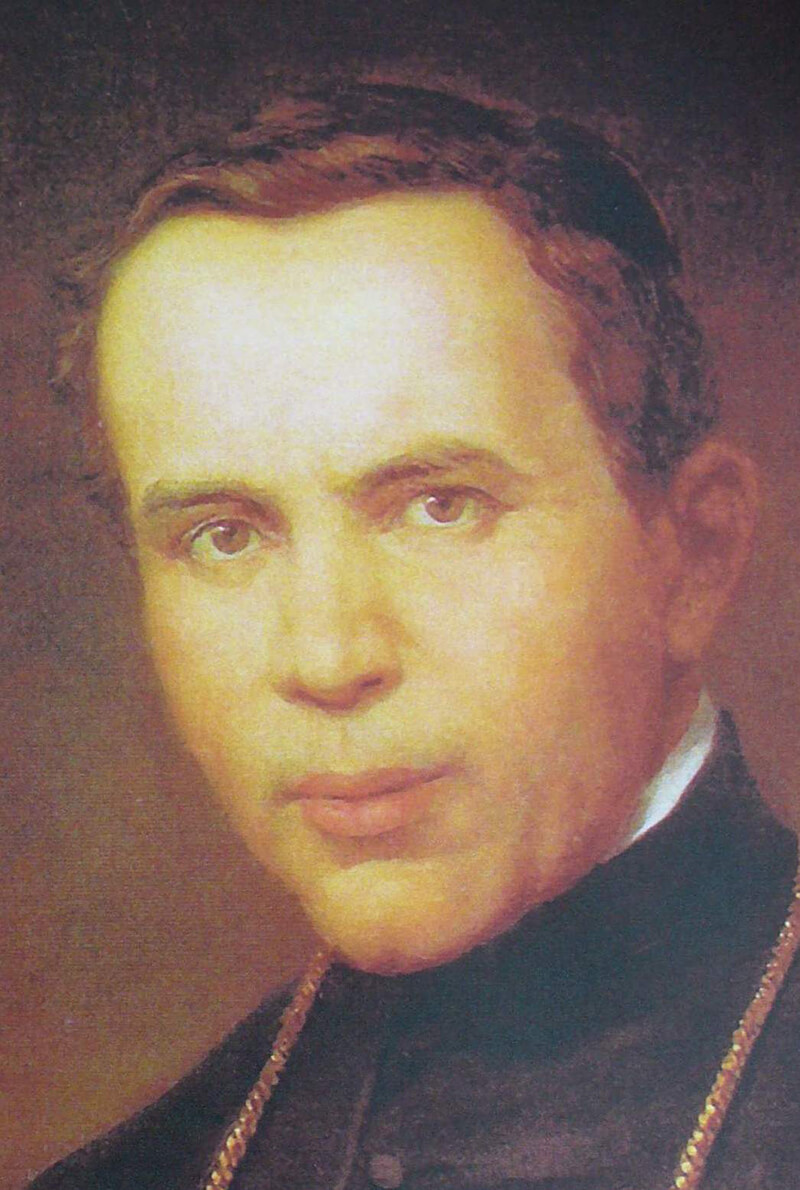
It is a comfort for the people of Rochester, N.Y., to know that a canonized saint lived in their midst. The saint was John Nepomucene Neumann, a Redemptorist priest who died as bishop of Philadelphia. Rochester Catholics should, therefore, learn about this heroic apostle. And all other American Catholics as well.
John was born in Bohemia (now the Czech Republic) of a German father and a Slavic mother. From the start he was notable for his seriousness, his devotion, and his ability as a student. It was no surprise that, as he grew up, he felt a calling to the priesthood, and pursued the studies that were required. He intended to be ordained a priest of his home diocese of Budweis. By the time he completed his studies, however the bishop of Budweis had more than enough priests; and declined to ordain this new candidate. John saw in this fact a confirmation of his yen to become a missionary in the United States. He had read that the German-speaking immigrants over here were crying out for priests. Though not yet ordained a priest, he wrote to John Dubois, bishop of New York, offering his services in that diocese, which then embraced all of New York State. No word of acceptance arrived, so the young deacon set out anyhow on the long, hard journey. When he reached New York, he had one suit of clothes and one dollar to his name. But he received a warm welcome from Bishop Dubois, who had written to Europe three weeks before of his acceptance. Neumann’s boat and the mail boat had apparently passed each other at sea. Dubois ordained this immigrant deacon to the priesthood in old St. Patrick’s Cathedral, Mott Street, Manhattan, on Saturday, June 25, 1836. The bishop then assigned him to work among the Germans in the vicinity of Buffalo. He left New York on June 28, and by the end of the following month he had begun his apostolate, working out of Williamsville.
The new little “German” priest proved to be a true missionary. He worked up and down in western New York as far east as Batavia, building churches, opening schools, teaching, preaching and administering the sacraments. His ability with six languages proved very helpful. During these early years, he made his first contact with the German Redemptorist Fathers who had lately begun to work among the Germans of western New York. Attracted to them, Father John applied to join their society after four years as a diocesan priest. He took his vows in 1842 – the first Redemptorist to be professed in America. Father Neumann’s career as a Redemptorist was quiet but effective. His skill as well as his holiness prompted the Redemptorists to promote him to the post of head of the order in the United States. In 1852, he was named bishop of Philadelphia. For the next eight years, he proved to be a deeply spiritual pastor – ever humble and unobtrusive, but still a true missionary in prayer and work. He died suddenly of a stroke as he walked the streets of Philadelphia on church business.
Where does Rochester fit into this biography? At the very beginning of his priestly career. When Bishop Dubois sent the new priest to Buffalo in 1836, he told him to stop off for a week in Rochester to say Mass for the German Catholics there. They had recently been organized into a congregation by the Redemptorists. Thus it was that St. John, arriving in Rochester on the 4th of July, 1836, preached his first sermon as a priest and administered his first baptism (both in old St. Patrick’s Church). Then he went on to Buffalo, where he arrived by the Erie Canal on July 12. Later on, as a Redemptorist, Father John came back to Rochester many times. His name stands in the Rochester parish register. His contacts with us were, therefore, only transient, but they still give Rochesterians, Buffalonians, and Philadelphians a right to consider Bishop John, canonized in 1977, as one of their own. --Father Robert F. McNamara
Scripture. (1 Corinthians 9:16-19, 22-23)
Although I am free in regard to all,
I have made myself a slave to all
so as to win over as many as possible.
To the weak I became weak, to win over the weak.
I have become all things to all, to save at least some.
All this I do for the sake of the gospel,
so that I too may have a share in it.
Writings
Musical Selection