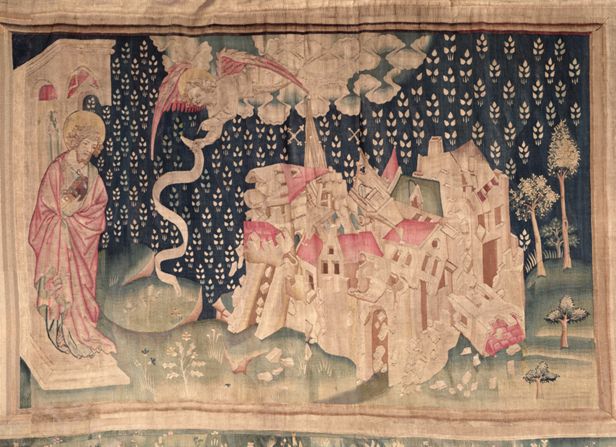
Rome's Judgment Still Incomplete
These are great and notable events, and certainly form part of the predicted judgment upon Rome; at the same time they do not adequately fulfil the prophecy, which says expressly, on the one hand, that the ten portions of the empire itself which hath almost been slain, shall rise up against the city, and "make her desolate and burn her with fire," which they have not yet done; and on the other hand, that the city shall experience a total destruction, which has not yet befallen her, for she still exists. St. John's words on the latter point are clear and determinate. "Babylon the great is fallen, is fallen; and is become the habitation of devils, and the hold of every foul spirit, and a cage of every unclean and hateful bird;" words which would seem to refer us to the curse upon the literal Babylon; and we know how it was fulfilled.
The prophet Isaiah had said, that in Babylon "wild beasts of the desert should lie there, and their houses be full of doleful creatures, and owls should dwell there, and satyrs" or devils, "should dance there." And we know that all this has happened to Babylon; it is a heap of ruins; no man dwells there; nay it is difficult to say even where exactly it was placed, so great is the desolation. Such a desolation St. John seems to predict, concerning the guilty persecuting city we are considering; and in spite of what she has suffered, such a desolation has not come upon her yet. Again, "she shall be utterly burnt with fire, for strong is the LORD GOD, who judgeth her." Surely this implies utter destruction, annihilation. Again, "a mighty angel took up a stone, like a great millstone, and cast it into the sea, saying, Thus with violence shall that great city Babylon be thrown down, and shall be found no more at all."
To these passages I would add this reflection. Surely Rome is spoken of in Scripture as a more inveterate enemy of GOD and His saints even than Babylon, as the great pollution and bane of the earth: if then Babylon has been destroyed wholly, much more, according to all reasonable conjecture, will Rome be destroyed one day.
It may be further observed, that serious men in the early Church certainly thought that the barbarian invasions were not all that Rome was to receive in the way of vengeance, but that GOD would one day destroy it by the fury of the elements. "Rome," says one of them, at a time when a barbarian conqueror had possession of the city, and all things seemed to threaten its destruction, "Rome shall not be destroyed by the nations, but shall consume away internally, worn out by storms of lightning, whirlwinds, and earthquakes."
This is what may be said on the one side, but after all something may be said on the other; not indeed to show that the prophecy is already fully accomplished, for it certainly is not, but to show that, granting this, what accomplishment remains has reference not to Rome, but to some other object or objects of divine vengeance. I shall explain my meaning under two heads.
Musical Selection
scelesta, in perpetuum maledicta, aeternis erit ignibus
addicta!
and the transgressors, cursed for ever,
shall be condemned to everlasting fire!