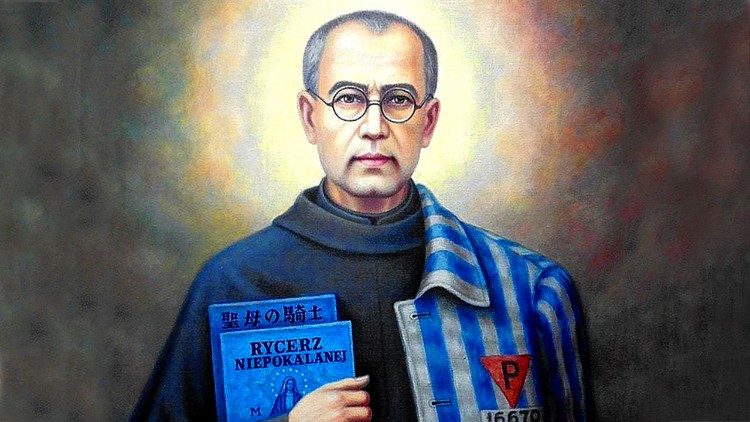
The very name Auschwitz evokes memories of the hellish cruelty of all the Nazi prison camps. Yet these camps also produced heroes. St. Maximilian Kolbe was a glorious example.
Baptized Raymond, Kolbe was the son of poor, devout Polish villagers. He was a lively, mischievous child, and his mother once sighed, “What is to become of you?” Little Raymond decided to ask Our Lady. When he came home from church he told his mother that Mary had appeared to him there, shown him a white crown (for purity) and a red crown (for martyrdom). “Which do you choose?” she said. “I choose both,” he replied. Mary smiled and vanished.
Assisted by generous friends, Raymond received a good schooling. In 1910 he entered the Conventual Franciscans, receiving, with their black habit, the religious name Maximilian. Though torn at first between friardom and science (he was brilliant in natural sciences), he stuck out the novitiate and took his vows. The superiors then sent him to Rome for priestly studies. An outstanding student, he won doctorates in philosophy and theology, and was ordained a priest in 1918.
By 1918 he had already discerned his particular mission. Appalled by the lukewarmness of Catholics in serving God, he decided to form a pious confraternity, the Militia of Mary Immaculate, which would undertake a vigorous apostolate of the press. Its “knights” would work for the salvation of souls, especially of enemies of the Church. The result was the foundation at Niepokalanow of the “City of the Immaculate”, a self-sustaining press center. Despite financial problems and the founder’s bout with tuberculosis, it succeeded. Fr. Maximilian then went to Japan, where he set up another “City”; and a third one was established in India.
In 1939, Fr. Kolbe was recalled from Japan and named superior at Niepokalanow. But the Nazis invaded Poland on September 1, 1939. They showed no fondness for Catholic publication enterprises. Fr. Maximilian was arrested briefly that same year. In 1941 he was again arrested. Although his lung trouble reasserted itself in captivity, he and 320 other Polish prisoners were transferred to the prison camp that the Nazis had erected at Auschwitz (Oswiecim) in Poland.
Because he publicly acknowledged himself to be a Catholic priest, Fr. Kolbe, despite his physical frailty, was saddled with the heaviest and most degrading tasks. On one occasion he was severely beaten and left for dead. But he constantly sacrificed himself for those around him, and was their sole comfort. A Protestant camp doctor later said, “In Auschwitz, I knew of no other similar case of such heroic love of neighbor.”
One evening in the summer of 1941 a prisoner managed to break out. The vicious camp rule declared that if any escapee was not caught, ten other prisoners would be killed in reprisal. Now the commandant lined up his prisoners and selected ten victims at random. One of them, a Polish soldier, Sgt. Francis Gajowniczek, cried out in anguish, “What will happen to my family?” Thereupon Fr. Maximilian approached the commandant, doffed his cap politely, and said, “I am a Catholic priest from Poland. I would like to take his place, because he has a wife and children.”
Surprisingly, Commandant Fritsch consented. So Kolbe and the other nine were locked up in the starvation bunker. For two weeks they suffered excruciatingly. But led by the priest, they raised their voices not in pain or blame, but in singing hymns and reciting the rosary. Only the priest and three others were still alive on August 14. They were killed that day by lethal injection.
In 1971 Pope Paul VI declared this celibate friar “blessed” as a confessor (that is, a non-martyr). Pope John Paul canonized him in 1982, this time as a martyr: one who, at least in a wider sense, had died for his faith. Thus did St. Maximilian Kolbe receive both the crowns that Mary Immaculate had promised him long ago in his village church. --Father Robert F. McNamara
Scripture(1 John 3:14-18)
Beloved: We know that we have passed from death to life because we love our brothers. Whoever does not love remains in death. Everyone who hates his brother is a murderer, and you know that no murderer has eternal life remaining in him. The way we came to know love was that he laid down his life for us; so we ought to lay down our lives for our brothers. If someone who has worldly means sees a brother in need and refuses him compassion, how can the love of God remain in him? Children, let us love not in word or speech but in deed and truth.
Writings
(Year A) The purpose of creation, the purpose of man is the love of God, the Creator and the Father; an ever greater love, divinization, return to God from whom he came, union with God, a fruitful love. So that the love toward the Father could become even more perfect, infinitely more perfect, the love of the Son Jesus was manifested. He came down to earth, died on the Cross and has remained in the Eucharist, in order to awaken love toward Himself in our hearts. Yet, for the love toward the Son to be heightened and the love to the Father to burn with even more ardent zeal, there comes to our aid the love of the Spirit, of the Immaculata, the one full of mercy, the Mediatrix of all graces, an earthly creature like us, who strongly attracts hearts to herself by way of her Motherly Heart. And just as the love of God for creatures descends to earth from the Father through the Son and the Spirit, so through the Spirit and the Son there ascends up to the Father a response to such love, a reaction, the love of creation toward the Father. The love of the Father, of the Son, and of the Spirit burns for all eternity. The love of the Father, of Jesus, of the Immaculata knows no imperfections. Only man (not always, not entirely) imperfectly reciprocates such love with love. In other words to elicit such love toward the Immaculata by kindling it in one’s heart and to communicate such fire to those who live around us; to kindle all souls, and each one individually, with such love: the souls who live now and shall live in the future. To set such flame of love within oneself ablaze ever more forcefully and without restrictions, all over the earth: that is our goal. Everything else is merely a means. An effect is similar to the cause. Consequently, each creature carries in itself a likeness to God; and the more perfect a creature is, the more such likeness is evident. God is love, Most Holy Trinity. So also the mutual love of people who come together to form a family is a true echo of divine love. The mutual love between a father, a mother, and a son. In the realm of the spirit such love, which joins the intellect, the will and one’s being, is even more strongly asserted. Any representation of such love, even the most spiritual, the most perfect, will always continue to be infinitely distant from the very Source of love, God. Even if we were able to enumerate thousands upon thousands of degrees, more and more perfect, more and more spiritually pure, there would still be an infinite distance between those higher degrees and the Source of love. God lowers Himself toward His own creature and joins Himself to them with a love that absorbs all that infinite space: He takes them into His own family, makes them His own children. The soul is regenerated in the water of Holy Baptism and thus becomes a child of God. Water, which purifies everything it washes over, is a symbol of the One who purifies every soul that approaches her; it is a symbol of the Immaculata, of the One who is without blemish. Upon those who are washed by that water, there descends the grace of the Holy Spirit. The Holy Spirit, divine Spouse of the Immaculata, acts solely in her and through her, communicates supernatural life, the life of grace, divine life, the partaking of the love of God, of divinity. The child of God, a member of the divine family, has God the Father as a father, the Mother of God as a mother, the Son of God as a brother. He becomes co-heir of God, joined to the Persons of the divine family through love. Yet that is not enough. The Son of God chooses brides among the souls, binds Himself to them with a family-like love and they become for Him the mothers of many, many other souls. Surrender, my soul, into the hand of your Father!
Musical Selection
There is no greater love, says the Lord, than to lay down your life for a friend;
there is no greater love, no greater love, than to lay down your life for a friend.
As the Father has loved me, so I have loved you. Live on in my love.
You will live in my love if you keep my commands, even as I have kept my Father's.
All this I tell you that my joy may be yours and your joy may be complete.
Love one another as I have loved you: This is my command.
You are my friends if you keep my commands; no longer slaves but friends to me.
All I heard from my Father, I have made known to you: Now I call you friends.
It was not you who chose me, it was I who chose you, chose you to go forth and bear fruit.
Your fruit must endure, so you will receive all you ask the Father in my name.
Collect
Eternal God, your servant, the friar Maximilian Kolbe, bore witness to Christ’s victory over death and took the place of another in martyrdom: may we have courage in the time of trial and always put the needs of others before our own desires. Grant this through Jesus Christ your Son our Lord, who lives and reigns with you, in the unity of the Holy Spirit, God, now and for ever. Amen.(English Missal)