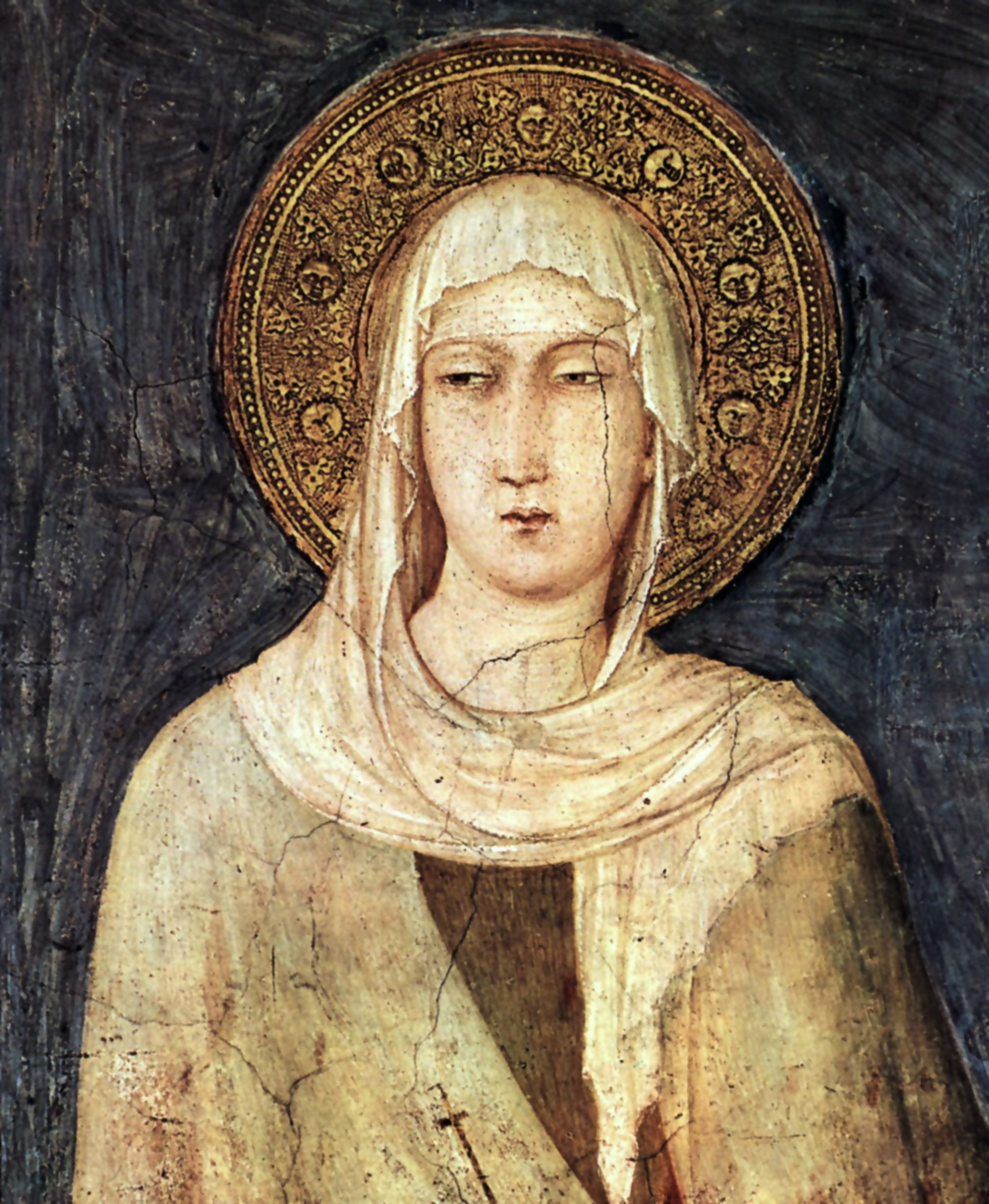
St. Clare of Assisi
August 11
Life (1193-1253)
St. Francis of Assisi is greatly loved as the saint of poverty and simplicity. He had a female counterpart who, inspired by him, founded the women’s Second Order of Franciscans. She was St. Clare of Assisi, and her order is commonly called the Poor Clares.
Clare was of a noble Assisian family, and shared with her sister Agnes a devotional spirit. When she was 18, her fellow townsman, St. Francis, then about 28, preached the Lenten sermons in the church of St. George in Assisi. Clara Offreduccio (that was her full name) was entranced by his exhortation to take the gospel itself as the rule of life. She consulted with Francis afterwards, and he urged her strongly to hold the world in disdain and to devote her life to Christ alone. She accepted the challenge and he pledged to assist her.
On the evening of Palm Sunday, 1212, Clare left home in secret and went to the residence of the Franciscans at the church of the Portiuncula. Here the friars received her solemnly and Francis cut her hair and gave her a tunic of sackcloth to replace her fine clothing. She thus became the first candidate for the Franciscan Second Order. St. Francis had no convent for her at that time so he placed her with some Benedictine nuns in another city.
When her family became aware of Clara’s “elopement”, they came to get her and bring her home. They even tried to pull her away from the altar, it is said; but she would not yield in her purpose. Francis soon transferred her to another convent. There her sister Agnes joined her. Francis eventually secured a modest little home for them next to the Assisi church of San Damiano. He constituted them a religious order and named Clare, despite her protests, to be the superior. Other candidates joined Clare and Agnes there, including even her mother and another sister. The order spread rapidly in Italy, France and Germany. In Prague, Blessed Agnes, the daughter of the King of Bohemia, founded a Franciscan convent. Abbess Agnes and Abbess Clare proved to be kindred spirits.
The Clarissas could not go from town to town preaching, as did the Franciscan friars. But they could practice the dedication to Lady Poverty that was so characteristic of the Friars Minor. They begged their provisions from door to door. Their life in the convent was one of stark simplicity. At the start, the acts of self-denial performed by the nuns were almost appalling. But Clare soon learned the need of discretion; and while austerity remained their common practice, she insisted that it be a “sacrifice seasoned with the salt of prudence”.
The popes at times tried to dissuade St. Clare, as they tried to dissuade St. Francis, from embracing a radical poverty. Some of the Clarissa convents did accept an interpretation of poverty that allowed the community itself to own some property. Clare herself rejected this approach, and drew up a final rule that sustained the ban on all ownership by either the nuns or the convents.
St. Clare governed her convent, despite poor health, for four decades. In her monastery she ruled not by commanding but by serving others, even as Francis did. She had a profound devotion to the Blessed Sacrament, and her face often grew dazzlingly bright as she prayed in its presence.
In 1244 German Emperor Frederic II, at war with the pope, invaded the papal province of Umbria. A detachment of his soldiers who were Muslims came over to plunder Assisi. They first attacked St. Clare’s convent, which was outside the city walls. Clare had the Blessed Sacrament put into a monstrance and set up in a place visible to the invaders outside. Then she prayed that God would protect her sisters and her native city. The answer came in a heavenly childlike voice: “I will have them always in my care.” At that moment the assailants were struck with a strange terror and fled. Both the convent and the city were saved.
St. Clare survived St. Francis 27 years. Three of his dearest friars, Brothers Leo, Angelo and Juniper, as well as her sister St. Agnes, helped her to prepare for death. Her last words could have come from the lips of Francis himself: “Blessed be thou, O God, for having created me.” Have we ever thought of thanking God for bringing us into being? -- Father Robert F. McNamara
(Year A). After the most high heavenly Father saw fit by his grace to enlighten my heart to do penance according to the example and teaching of our most blessed Father, Saint Francis, I, together with my sisters, willingly promised him obedience shortly after his own conversion. When the blessed Father saw we had no fear of poverty, hard work, trial, shame, or contempt of the world, but, instead, regarded such things as great delights, moved by compassion he wrote a form of life for us as follows: 'Because by divine inspiration you have made yourselves daughters and servants of the Most High King, the heavenly Father and have espoused yourselves to the Holy Spirit, choosing to live a life according to the perfection of the holy Gospel, Resolve and promise for myself and for my brothers to always have that same loving care and solicitude for you as I have for them.' As long as he lived he diligently fulfilled this and wished that it always be fulfilled by his brothers. Shortly before his death he once more wrote his last will for us that we or those, as well, who would come after us would never turn aside from the holy poverty we had embraced. He said: 'I , little brother Francis, wish to follow the life and poverty of our most high Lord Jesus Christ and of his Holy Mother and to persevere in this until the end; and I ask and counsel you , my ladies, to live always in this most holy life and poverty. And keep most careful watch that you never depart from this by reason of the teaching or advice of anyone.' As I, together with my sisters, have ever been solicitous to safeguard the holy poverty which we have promised the Lord God and blessed Francis, so, too, the Abbesses who shall succeed me in office and all the sisters are bound to observe it inviolably to the end. That is, by not receiving or having possession or ownership either of themselves or through an intermediary, or even anything that might reasonably be called property. (Rule)