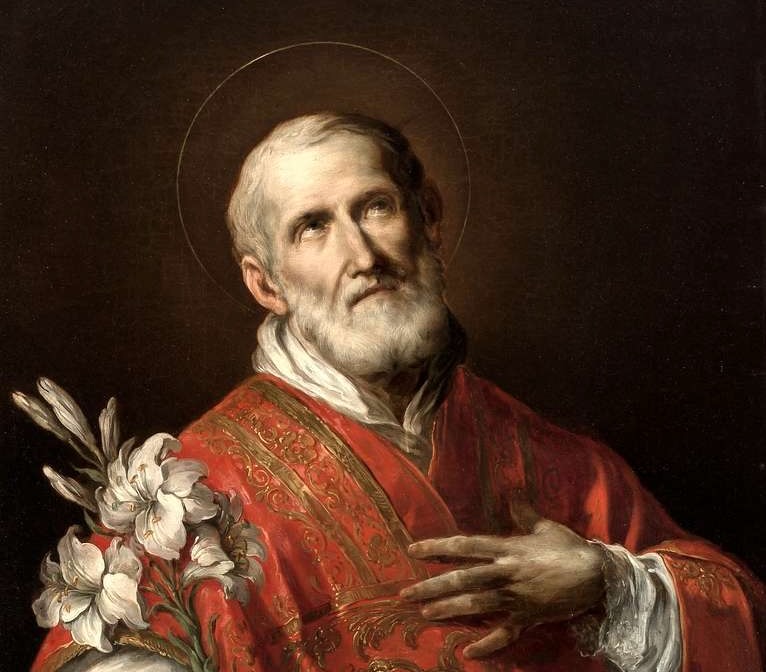
When Martin Luther complained in the early 16th century that moral life in Rome was lax, he was correct. Other reformers who remained within the Church agreed. The main problem was how to overcome the spirit of worldliness that tainted Romans from the popes on down to the tradesmen. Nobody likes to be reformed! What was needed was not just a series of new rules imposed from above, but a new spirit working up from below. God now gave to the Eternal City several saints who served as new yeast. The most outstanding was St. Philip Neri. Despite the fact that the apostles Peter and Paul were revered as founders of Roman Christianity, Philip came to be known as the “Apostle of Rome.” Philip was not a native Romano. He was born in Florence, the son of a notary public. From childhood on, he had a winning way about him that attracted everybody. People even called the lad “Pippo buono” (“good little Phil”) He was slated for a business career: and he would, in fact, have proved a skilled salesman. But at age 18 he underwent a spiritual experience that completely redirected his career.
Converted totally to God, Philip, like many other Spirit-shaken persons in history, decided to become a hermit. But to do so, he went, not to a desert, but to the city of Rome. His “hermitage” was a little room under the eaves. There, nevertheless, he did withdraw as much as possible from social contacts for the next two years. He occupied himself with prayer and with forms of self-denial that were effective without being extreme. When two years were up, Neri suddenly left his little cloister and plunged into the crowds that coursed through the streets of the metropolis. Using his talent for friendliness, he would pick up conversations with those he met, especially promising young men. He won their attention by his cheerful work, his banter, and even by clowning around. Then, when he had won listeners, he would ask, “Well, brothers, when shall we begin to do good?” The program through which he led them, like a pied piper, included group pilgrimages to the catacombs and the “seven churches” of Rome; and ended up in the hospitals, where they volunteered to serve the sick.
About this time, Philip had one of his many mystical experiences. Praying for the gifts of the Holy Spirit, he saw a globe of fire plunge into his mouth and enter his heart. With it came an intense emotionality that evidenced itself afterwards whenever he thought about God. As a matter of fact his physical heart was so enlarged from that moment that his ribs were broken. Thus far, Neri was a layman. In 1551, urged by priests, he became a priest at age 36. Soon he and a few other reform-minded priests joined to form a society he called the “Congregation of the Oratory.” They scheduled regular group-devotions in the large church hall which they called their “oratory.” Crowds of people, from cardinals on down, gathered to give or listen to sermons, read church history and saints’ lives, discuss religious subjects, and pray. Music was also introduced, and the religious cantata called the “oratorio” probably derived its name from Philip’s “Oratory” program. Philip was available to all, and crowds called at his office. (One day an observer saw four cardinals visiting the saint at the same time.) His recommendation to all was frequent confession and daily communion.
Why did Philip Neri attract people as a magnet attracts nails? Partly because of his spontaneous challenges. Sometimes he would bully his pupils or box their ears, as a father might his son’s. Sometimes he would break their self-love by ordering them to do something absurd. But they didn’t mind. They recognized that he made closeness to God a social reality, and they kept coming to his services. By the end of his life, this “holy clown” had begun to alter the whole moral atmosphere of Rome. Philip, you see, firmly believed that “the soul of reform is the reform of the soul;” and he communicated to his followers the optimistic view that they could “begin to do good.” Typical of his homely piety were his axioms “God tries no one too far.” and “He leaves everyone some bone to gnaw.” By his own example he convinced people that serving God should be and could be a joyful experience. -Father Robert F. McNamara
Scripture(Phil 4:4-9)
Rejoice in the Lord always. I shall say it again: rejoice! Your kindness should be known to all. The Lord is near. Have no anxiety at all, but in everything, by prayer and petition, with thanksgiving, make your requests known to God. Then the peace of God that surpasses all understanding will guard your hearts and minds in Christ Jesus. Finally, brothers and sisters, whatever is true, whatever is honorable, whatever is just, whatever is pure, whatever is lovely, whatever is gracious, if there is any excellence and if there is anything worthy of praise, think about these things. Keep on doing what you have learned and received and heard and seen in me. Then the God of peace will be with you.
Writings
(Year A) 1. He who wishes to be wise without the true Wisdom, or saved without the Saviour, is not well, but sick - is not wise, but a fool. 2. Devotion to the Blessed Virgin is actually necessary, because there is no better means of obtaining God’s graces than through His most holy mother. 3. A man should force himself to be obedient, even in little things which appear of no moment; because he will thus render the practice of obedience in great matters easy to himself. 4. He who always acts under obedience, may rest assured that he will not have to give an account of his actions to God. 5. Perfection does not consist in such outward things as shedding tears and the like, but in true and solid virtues. 6. Tears are no sign that a man is in the grace of God, neither must we infer that one who weeps when he speaks of holy and devout things necessarily leads a holy life. 7. Cheerfulness strengthens the heart and makes us persevere in a good life; wherefore the servant of God ought always to be in good spirits. 8. When a man is freed from a temptation or any other distress, let him take great care to show fitting gratitude to God for the benefit he has received. 9. We must accept the adversities which God sends us without reasoning too much upon them, and we must take for granted that it is the best thing which could happen to us. 10. We must always remember that God does everything well, although we may not see the reason of what He does. 11. Every one ought to give in readily to the opinion of another, and to argue in favour of another and against himself, and take things in good part. 12. There is nothing more to the purpose for exciting a spirit of prayer, than the reading of spiritual books. 13. Let a man frequent the holy Sacraments, go to sermons, and be often reading the Lives of Saints. 14. Let a man always think that he has God before his eyes. 15. When a man is in an occasion of sin, let him look what he is doing, get himself out of the occasion, and avoid the sin. 16. There is nothing good in this world: Vanitas vanitatum, et omnia vanitas. 17. We must die at last. 18. Beginners in religion ought to exercise themselves principally in meditation on the Four Last Things. 19. He who does not go down into hell while he is alive, runs a great risk of going there after he is dead. 20. The greatest help to perseverance in the spiritual life is the habit of prayer, especially under the direction of our confessor. 21. There is nothing the devil fears so much, or so much tries to hinder, as prayer. 22. An excellent method of preserving ourselves from relapsing into serious faults, is to say every evening, “To-morrow I may be dead.” 23. A man without prayer is an animal without the use of reason. 24. The religious state is indeed the highest, but it is not suitable for all. 25. A most excellent means of learning how to pray, is to acknowledge ourselves unworthy of such a benefit, and to put ourselves entirely into the hands of the Lord. 26. The true preparation for prayer consists in the exercise of mortification; for he who wishes to give himself up to prayer without mortification, is like a bird wishing to fly before it is fledged. 27. We can never arrive at the contemplative life, if we do not first exercise ourselves laboriously in the active life. 28. We must exercise the spirit which God gives us in prayer, and follow that; so that, when, for example, it inclines us to meditate on the Passion, we must not wish to meditate on some other mystery. 29. When a person goes to communion, he ought to follow the same spirit he had in prayer, and not be casting about for new meditations. (Maxims; February)
Musical Selection
God never moves without purpose or plan
When trying His servant and molding a man
Give thanks to the Lord though your testing seems long
In darkness He giveth a song
O Rejoice in the Lord
He makes no mistake
He knoweth the end of each path that I take
For when I am tried
And purified
I shall come forth as gold
I could not see through the shadows ahead
So I looked at the cross of my Savior instead
I bowed to the will of the Master that day
Then peace came and tears fled away
Now I can see testing comes from above
God strengthens His children and purges in love
My Father knows best, and I trust in His care
Through purging more fruit I will bear
O Rejoice in the Lord
He makes no mistake
He knoweth the end of each path that I take
For when I am tried
And purified
I shall come forth
I shall come forth
I shall come forth as gold
Collect
Father, who continually raises up the faithful to the glory of holiness: in your love kindle in us thefire of the Holy Spirit who sofilled the heart of Philip Neri. Grant this through Jesus Christ your Son our Lord, who is lives and reigns with you, in the unity of the Holy Spirit, God, now and for ever. Amen.(English Missal)