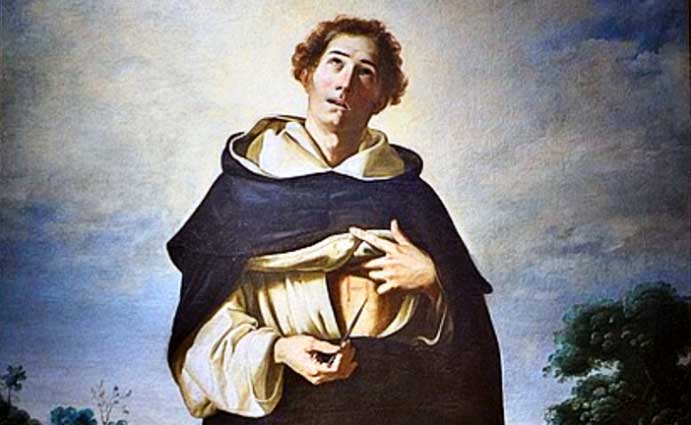
Blessed Henry Suso was born in 1300 at Constance in Germany. There he entered the Dominican convent at the age of thirteen, and made his preparatory studies in the sacred disciplines. In 1327 he became a teacher of theology, and in 1334 began preaching. In 1343 he was elected prior of a convent at Diessenhofen. Blessed Henry is known especially as a mystic who regarded himself as the servant of Eternal Wisdom become Man. He practiced severe austerities and experienced, along with his visions and ecstasies, bitter persecutions and grievous calumnies.
He assisted in the restoration of strict religious observance in the cloisters, especially in the Dominican convents for women at Katherinentahl and T?ss. One of the Superiors in these convents preserved most of his letters and obtained the history of his life, which he himself later edited and published. As a preacher he was highly esteemed in many Swiss and Dutch cities. It is said that for 150 years there was no book of meditation more widely read in the German language than his Little Book of Eternal Wisdom. Blessed Henry translated this work into Latin as well, and added at that time to its contents.
He died in 1366; 250 years later, in 1613, workers in the old convent at Ulm found his body perfectly conserved and emitting a pleasant fragrance. Unfortunately the non-Catholic authorities of the city had the tomb closed; and the Bollandists, famous hagiographists of 19th century France, wrote in 1882 that no trace was any longer known of it. He was declared Blessed in 1831 by Pope Gregory XVI.
The Catholic Encyclopedia, edited by C. G. Herbermann with numerous collaborators (Appleton Company: New York, 1908); Les Petits Bollandistes: Vies des Saints, by Msgr. Paul Guérin (Bloud et Barral: Paris, 1882), Vol. 3.
Scripture (Rom 12:1-3)
I urge you, brothers and sisters, in view of God’s mercy, to offer your bodies as a living sacrifice, holy and pleasing to God—this is your true and proper worship. Do not conform to the pattern of this world, but be transformed by the renewing of your mind. Then you will be able to test and approve what God’s will is—his good, pleasing and perfect will. For by the grace given me I say to every one of you: Do not think of yourself more highly than you ought, but rather think of yourself with sober judgment, in accordance with the faith God has distributed to each of you.
Writings
(Year A). I desire from the boundless abyss of my heart that all the sufferings and grief that I have ever experienced, and, in addition, the painful suffering of all hearts, the pains of all wounds, the groans of all the sick, the sighs of all sad people, the tears of all weeping eyes, the insults suffered by all those oppressed, the needs of all poor indigent widows and orphans, the dire wants of all the thirsty and hungry, the blood spilled by all martyrs, the breaking of their selfish wills by all the joyful and blossoming youth, the painful practices of all the friends of God, and all the hidden and open suffering and sorrow that I or any other afflicted person ever experienced with regard to their bodies, possessions, reputation, friends and relatives, or depression, or whatever any man shall suffer up to the last day—I desire that all this may praise you eternally, heavenly Father, and honor your only-begotten suffering Son from eternity to eternity.
And I, your poor servant, desire to be today the devoted substitute for all suffering people who do not know how to bear their suffering in patient and thankful praise of God, so that I might offer up to you in their place today their sufferings, however they may have suffered. I offer it to you in their staid, just as if I myself alone had suffered it all physically and in my heart as I desired. And I present it today in their place to your only-begotten Son, that he may be praised by it forever and that those suffering may be consoled, whether they are still in this vale of lamentation or in the other world in your power. (The Life of the Servant)
Musical Selection (John Michael Talbot)