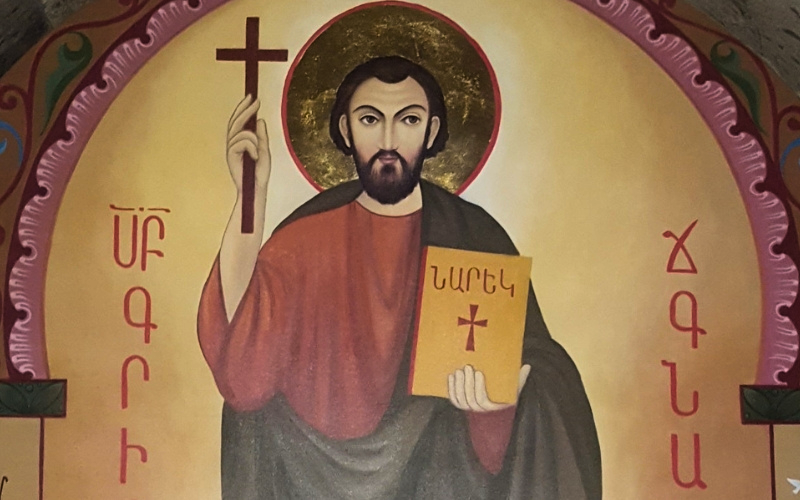
St. Gregory was born in the city of Narek about 950 A.D. He was a monk, poet, mystical philosopher, and theologian, born into a family of writers. St. Gregory received his education under the guidance of his father, Bishop Khosrov, author of the earliest commentary on the Divine Liturgy, and from Anania Vartabed, Abbot of Nareg Monastery. He and his two brothers entered monastic life at an early age. He became a priest at the age of 25 and dedicated himself to God completely, always searching for the truth. Most of his life he lived in the monasteries of Narek where he taught at the monastic school. He launched his writings with a commentary on the “Song of Songs,” which was commissioned by an Armenian prince. Despite his reservations that he was too young for the task, he wrote the commentary, which is famous for its clarity of thought and language, and its excellence of theological presentation. He also wrote a number of famous letters, sharagans, treasures, odes, melodies, and church writings. However, his masterpiece is considered to be his Book of Lamentations, commonly called “Narek,” in which his genius is displayed. (This work, published in 1673 in Marseille, has been translated into at least 30 languages.) Also known as The Prayer Book, it is described by St. Gregory as his last testament: “Its letters like my body, its message like my soul.” He called his book an “encyclopedia of prayer for all nations.” It was his hope that it would serve as a guide to prayer by people of all stations around the world.
St. Gregory of Narek is considered the greatest poet of the Armenian nation and its first and greatest mystic. His writing style and command of the Armenian language are unparalleled, and his saintly person has been an inspiration to the Armenian faithful for centuries. St. Gregory’s poetry is deeply biblical and is filled with images and themes of sacred history, while also distinguished with an intimate and personal character. Numerous miracles and traditions have been attributed to him and he is referred to as “the watchful angel in human form.” St. Gregory died in 1003 A.D.
Because all gold, in view of her, is a little sand,
and before her, silver is to be accounted mire.
Beyond health and comeliness I loved her,
And I chose to have her rather than the light,
because the splendor of her never yields to sleep.
Now God grant I speak suitably
and value these endowments at their worth:
For he is the guide of Wisdom
and the director of the wise.
For both we and our words are in his hand,
as well as all prudence and knowledge of crafts.
Writings
(Year A). Son of the living God, blessed in all things,1 inscrutably begotten by your awe-inspiring Father, for you nothing is impossible.2 Before the dawning of the uneclipsed rays of the mercy of your glory sins melt away, demons flee, transgressions are erased, bindings are cut and chains undone. The dead are born again, infirmities are cured, wounds are healed, corruption is cleansed, sadness withdraws, sighs retreat, darkness flees, fog departs, twilight vanishes, darkness lifts, the night passes, alarm is banished, evil is destroyed, despair is exiled. And your omnipotent hand rules, redeemer of all. You who came not to destroy our mortal souls, but to give them life,3 forgive my countless wrongs with your abundant mercy. For you alone are in heaven beyond words, and on earth beyond understanding, in the substance of existence unto the ends of the earth, the beginning of everything and the completion of everything in all ways, blessed in the highest. Glory forever to you with the Father and the Holy Spirit. (Lamentations)
Musical Selection (Lord's Prayer in Armenian)
Collect
Almighty and eternal God,
who gave your holy Church blessed Gregory as Doctor,
grant that what he taught when moved by the divine Spirit
may always stay firm in our hearts;
and, as by your gift we embrace him as our patron,
may we also have him as our defender to entreat your mercy.
Through our Lord Jesus Christ, your Son,
who lives and reigns with you in the unity of the Holy Spirit,