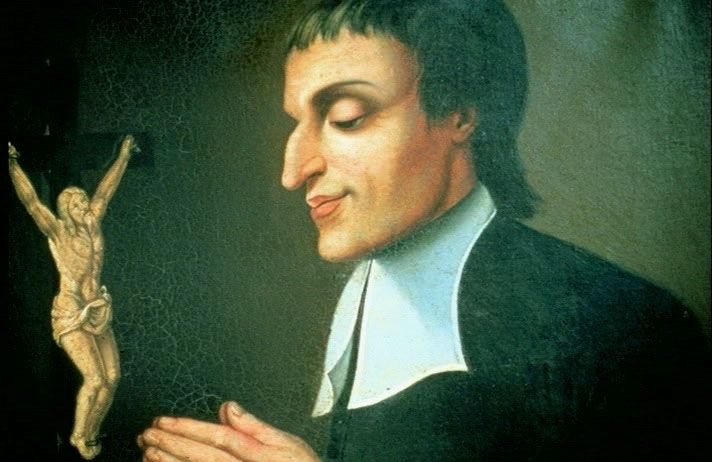
Life (1673-1716)
In December 1996, Pope John Paul II authorized the addition to the universal calendar of the Church, the April 28th feast of St. Louis-Mary of Montfort. A word of explanation. When saints are canonized, they are assigned a feast day, normally the date of their death; but to avoid overcrowding the liturgical calendar of the Latin Rite, the observance of their festivals is restricted to certain groups or localities. Those listed in the worldwide calendar are saints considered to be persons of worldwide significance. Why was this French priest honored as a major saint fifty years after his canonization? Let us see who he was and what he achieved.
Louis Grignion was born January 31, 1673, at Montfort-la-Canne, in French Brittany, eldest of the eight children of John Baptist Grignion, a man of modest means. Louis early developed a deep, trusting devotion to the Blessed Virgin. At confirmation he took her name and became simply “Louis-Mary de Montfort.” Educated at Rennes by the Jesuits, he felt called to the priesthood, for which he studied in Paris, first at the Sorbonne, then at the Seminary of St. Sulpice. He was ordained a priest in 1700, and enrolled in the Third Order of the Dominicans ten years later. Abbé Louis-Mary doubtless joined the Dominican Third Order because of its connection with the Rosary, his favorite devotion. He had become acquainted with the extensive literature of the French School of spirituality and had read practically every available book on Mary.
His first assignment after ordination was to a chaplaincy in a hospital for the poor at Poitiers. The young priest quickly showed talents as an organizer. Finding the management of the hospital disorderly, he reorganized it. He also gathered from among its female staff and residents, the nucleus of a nursing religious order, the Daughters of Wisdom (1703), which is still functioning internationally. But the improvements he made were not welcomed by the hospital, so he had to resign his post. He turned then to preaching popular missions to the vicinity’s poor; but his bishop, egged on by his enemies, forbade him to preach anymore within the diocese. Undismayed, Father Grignion walked to Rome on foot to seek missionary faculties from Pope Clement XI. The Pope received him graciously and sent him back to France with the title of “missionary apostolic.” Returning to his native Brittany, he spent the rest of his life there giving parish missions.
Even in his homeland, however, clerical critics arose who hampered his work. Some of these were imbued with a Jansenistic attitude: harsh, rigorous men who favored heavy penances and frowned on frequent Communion. These were “false prophets,” and deserved to be countered. Other critics, however, did not care for the young priest’s dramatic pulpit methods. But the people to whom he preached loved to listen to him for just that reason. At Rochelle, a Calvinist stronghold, he reconciled numerous French Protestants.
Louis-Mary laid special stress on the Rosary. He could even join a crowd of men singing obscene songs and persuade them to kneel down and pray the Rosary. The strong leader of an effective re-evangelization, St. Louis in 1705 founded another religious order, the missionaries of the Company of Mary (the Montfort Fathers) to continue the work begun. But the founder himself died a decade later, aged only 43.
Grignion had written several spiritual books during his life. Only in 1842 was the manuscript of his chief work discovered and published, to become one of history’s most influential works. True Devotion to the Blessed Virgin argued that since we are called on to become like Jesus, the best method would be to consecrate ourselves to Mary, the one perfect Christian, entrusting to her the whole task of our sanctification. Pope John Paul II illustrates well the popularity of his devotion and its effectiveness. His papal motto “Totus Tuus” (“Totally thine”) was intended to be a statement of his personal acceptance of Montfort’s commitment to Mary. Also, in 1917, Mary, appearing at Fatima, asked that all be consecrated to her Immaculate Heart. In 1973 the Marian Movement of Priests began to urge this practice around the world, with the subsequent backing of the present pope. Complete self-entrustment to Our Lady has thus become a powerful contemporary apostolate. Its 18th-century promoter certainly deserves to be recognized in the universal calendar of the Church. Why not join St. Louis-Mary in consecrating ourselves to Mary the Mother of God and our Mother. --Father Robert F. McNamara
Writings
In tua se clausit viscera factus homo.
Vera fides Geniti purgavit crimina mundi,
Et tibi virginitas inviolata manet.
Subvenias famulis, O benedicta, tuis.
Gloria magna Patri, compar sit gloria Nato,
Spiritui Sancto gloria magna Deo.
Amen.
O Virgin Mother of God,
He Whom the whole earth cannot contain,
enclosed Himself, made man, within your womb.
The true faith of the Son has cleansed the
world’s sins,
and your virginity remains inviolate.
Mother of tenderness,
the world is crying out to you for your help:
come to the aid of your servants, O blessed lady.
Great glory be to the Father,
equal glory be to the Son;
and the Holy Spirit, great glory to God. Amen.