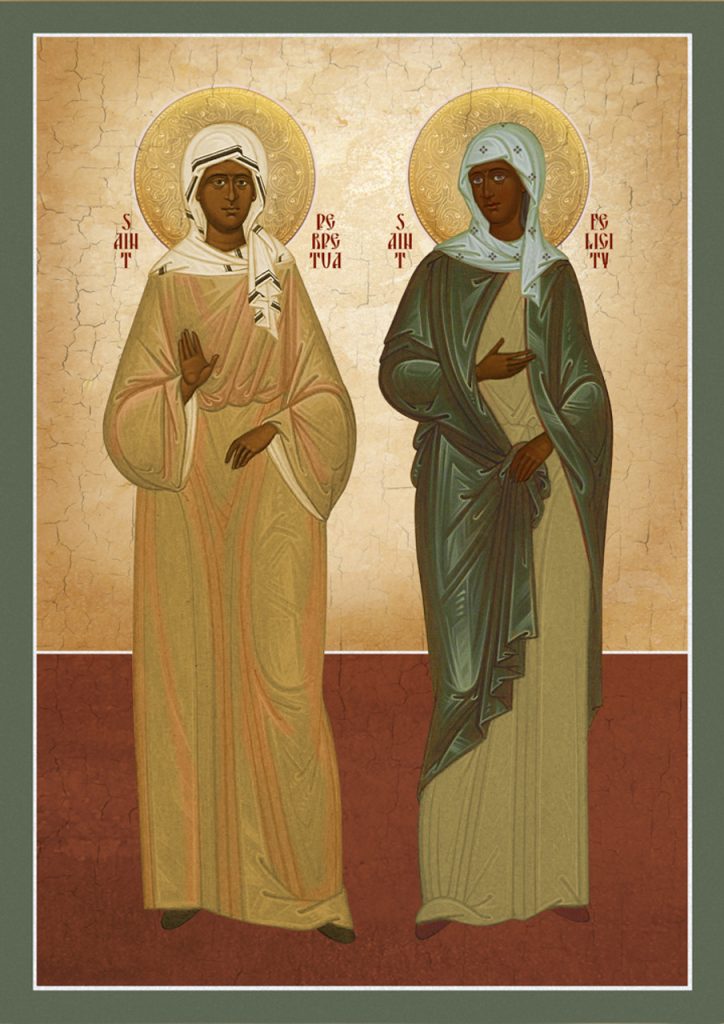
Of the several authentic accounts of early Christian martyrdom that have been preserved, none is so detailed as that of Saints Perpetua and Felicity of Carthage, and four Christian men. They died under the decree of the Emperor Septimius Severus. Severus was trying to stamp out Christianity by preventing conversion. Here the two women and three men arrested were catechumens, i.e., people under instruction for Christian baptism. The fourth man was Saturus, the priest who had been instructing them. Part of the account of their imprisonment was written by Perpetua herself; a second part by Saturus; and some eyewitness wrote the beginning and the conclusion.
Vibia Perpetua was a noblewoman aged 22, and mother of a small infant. Felicity was a slave, pregnant and close to term. The three male catechumens were Saturninus and Secundulus and the slave Revocatus. Saturus, though not a catechumen, joined them rather than be separated from them. Thus he had a chance to baptize them. On being arrested, the accused were first kept under house confinement. Perpetua’s old, pagan father kept persuading her to offer the required sacrifice. He used every ploy he could think of to break her will. But she stood firm. Pointing out an earthenware vessel nearby, she asked him, “Can that be called by any other name than what it is?” “No,” he answered. “So also,” she said, “I cannot call myself by any other name than what I am - a Christian.” Fortunately, all the catechumens had the opportunity to receive baptism during this first stage of imprisonment, most likely from Father Saturus. Next the captives were conveyed to a regular prison. It was pitch dark within and the guards stationed there mistreated them. Perpetua’s main concern, however, was that she had been separated from her baby, who was still at breast. Finally they brought her the child. After that, as far as she was concerned, the hideous prison almost became heaven. Perpetua was also heartened by several encouraging dreams or visions. In one she saw herself mounting a difficult ladder into heaven but being warmly welcomed there. In another, she beheld her little brother, who had died at seven from an ugly facial gangrene. In the vision, however, his face bore only a scar to recall the repulsive cause of his death.
As the day of execution approached, Felicity began to fear that her pregnancy would deprive her of the desired martyrdom. Roman law, with a strange mercy, forbade the execution of women with child. All the prisoners now joined in prayer for the prompt delivery of her child. The prayer was answered in due time. A soldier mocked the travail of the slave girl and asked how she could hope to suffer in the arena. She responded, “I suffer by myself now, but then another will suffer with me.” A faithful Christian promised to adopt the baby girl. The admirable behavior of the prisoners meanwhile resulted in the conversion of Pudens, their jailer. It was, as Shakespeare says, “A good deed in a naughty world.” When the martyrs-to-be were finally conducted into the arena (one, Secundulus, had already died in prison), the men of the group cried out a prophetic warning to the bystanders for their act of injustice. Perpetua meanwhile sang a song of triumph. Because they maintained such good cheer, orders were given for the gladiators to lash them as they entered. The wild animals sent in to play with the Christian group chose to remain unpredictable. The wild boar ignored Saturus and turned on its keeper, whom he mortally wounded. Perpetua and Felicitas were wounded by a mad heifer but not killed. Finally the gladiators were commanded to behead those not already dead. The martyrs then gave each other the sign of peace. The nervous gladiator assigned to dispatch Perpetua failed to kill her with the first blow. In the second she herself guided his hand.
News of this heroic witness spread rapidly through East and West Christendom. A basilica was raised over their tomb at Carthage. In Rome the names of the two valiant mothers, one free, one slave, were enshrined in the First Eucharistic Prayer like two flowers. As the poet, Alfred Barrett, put it: “Perpetua, Felicitas/Pressed in the Canon of the Mass.” --Father Robert F. McNamara
we are looked upon as sheep to be slaughtered.
No, in all these things we conquer overwhelmingly
through him who loved us.
For I am convinced that neither death, nor life,
nor angels, nor principalities,
nor present things, nor future things,
nor powers, nor height, nor depth,
nor any other creature will be able to separate us
from the love of God in Christ Jesus our Lord.
Writings
(Year A). If ancient examples of faith kept, both testifying the grace of God and working the edification of man, have to this end been set in writing, that by their reading as though by the showing of the deeds again, God may be glorified and man strengthened; why should not new witnesses also be so set forth which likewise serve either end? Yea, for these things also shall at some time be ancient and necessary to our sons, though in their own present time (through some reverence of antiquity presumed) they are made of but slight account. But let those take heed who judge the one power of the Holy Spirit according to the succession of times; whereas those things which are later ought for their very lateness to be thought the more eminent, according to the abundance of grace appointed for the last periods of time. For In the last days, says the Lord, I will pour my spirit upon all flesh, and their sons and daughters shall prophesy; and upon my servants and upon my handmaids I will pour forth of my spirit; and the young men shall see visions, and the old men shall dream dreams. [Acts 2:17, cf. Joel 2:28]
We also therefore, by whom both the prophecies and the new visions promised are received and honored, and by whom those other wonders of the Holy Spirit are assigned unto the service of the Church, to which also was sent the same Spirit administering all gifts among all men, according as the Lord hath distributed unto each [I.Cor 7:17]- do of necessity both write them and by reading celebrate them to the glory of God; that no weakness or failing of faith may presume that among those of old time only was the grace of divinity present, whether in martyrs or in revelations vouchsafed; since God ever works that which He has promised, for a witness to them that believe not and a benefit to them that believe. Wherefore we too, brethren and dear sons, declare to you likewise that which we have heard and handled [I Cor 15:1?]; that both you who were present may call to mind the glory of the Lord, and you who now know by hearing may have communion with those holy martyrs, and through them with the Lord Jesus Christ, to whom is glory and honor for ever and ever. Amen.
There were apprehended the young catechumens, Revocatus and Felicity his fellow servant, Saturninus and Secundulus. With them also was Vibia Perpetua, nobly born reared in a liberal manner, wedded honorably; having a father and mother and two brothers, one of them a catechumen likewise, and a son, a child at the breast; and she herself was about twenty-two years of age. What follows here shall she tell herself; the whole order of her martyrdom as she left it written with her own hand and in her own words.
Musical Selection
Confitebor tibi Domine Deus meus in toto corde meo et glorificabo nomen tuum in aeternum Quia misericordia tua magna est super me et eruisti animam meam ex inferno inferiore.
Collect
Holy God,
who gave great courage to Perpetua, Felicity and their companions:
grant that we may be worthy to climb the ladder of sacrifice
and be received into the garden of grace;
through Jesus Christ your Son our Lord,
who lives and reigns with you,
in the unity of the Holy Spirit,
God, now and for ever. Amen. (English Missal)