Introit
Collect
O God, who see how your people
faithfully await the feast of the Lord’s Nativity,
enable us, we pray,
to attain the joys of so great a salvation
and to celebrate them always
with solemn worship and glad rejoicing.
Through our Lord Jesus Christ, your Son,
who lives and reigns with you in the unity of the Holy Spirit,
God, for ever and ever. Amen. (RM)
First Reading Is 35:1-6a,10
The wilderness and the dry land shall be glad, the desert shall rejoice and blossom; like the crocus it shall blossom abundantly, 2 and rejoice with joy and singing. The glory of Lebanon shall be given to it, the majesty of Carmel and Sharon. They shall see the glory of the Lord, the majesty of our God. 3 Strengthen the weak hands, and make firm the feeble knees. 4 Say to those who are of a fearful heart, “Be strong, do not fear! Here is your God. He will come with vengeance, with terrible recompense. He will come and save you.” 5 Then the eyes of the blind shall be opened, and the ears of the deaf unstopped; 6 then the lame shall leap like a deer, and the tongue of the speechless sing for joy. 10 And the ransomed of the Lord shall return, and come to Zion with singing; everlasting joy shall be upon their heads; they shall obtain joy and gladness, and sorrow and sighing shall flee away.
Responsorial Psalm Ps 146:6-7,8-9,9-10
R/. Lord, come and save us.
Second Reading Jas 5:7-10
Be patient, beloved, until the coming of the Lord. The farmer waits for the precious crop from the earth, being patient with it until it receives the early and the late rains. 8 You also must be patient. Strengthen your hearts, for the coming of the Lord is near. 9 Beloved, do not grumble against one another, so that you may not be judged. See, the Judge is standing at the doors! 10 As an example of suffering and patience, beloved, take the prophets who spoke in the name of the Lord.
Alleluia Is 61:1 (cited in Lk 4:18)
Gospel Mt 11:2-11
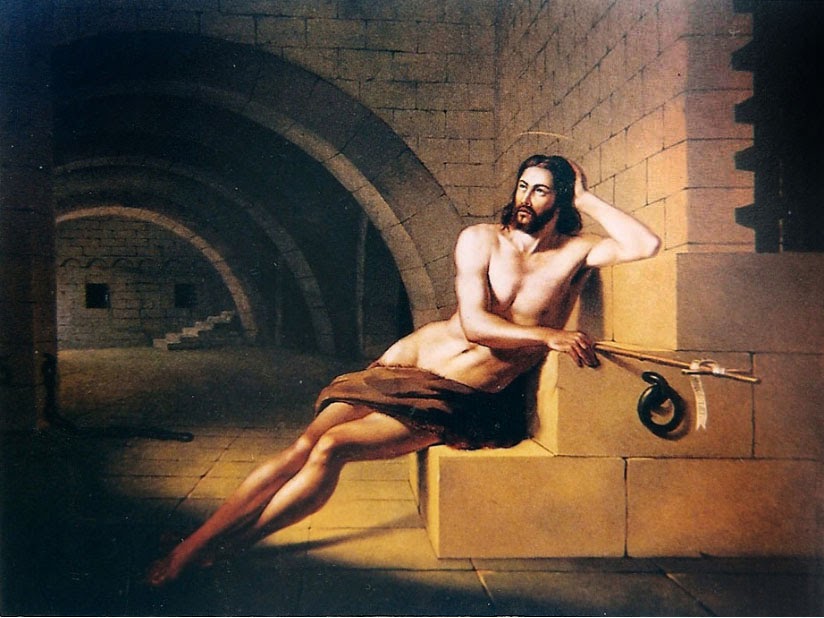
When John heard in prison what the Messiah was doing, he sent word by his disciples 3 who said to Jesus, “Are you the one who is to come, or are we to wait for another?” 4 Jesus answered them, “Go and tell John what you hear and see: 5 the blind receive their sight, the lame walk, the lepers are cleansed, the deaf hear, the dead are raised, and the poor have good news brought to them. 6 And blessed is anyone who takes no offense at me.” 7 As they went away, Jesus began to speak to the crowds about John: “What did you go out into the wilderness to look at? A reed shaken by the wind? 8 What then did you go out to see? Someone dressed in soft robes? Look, those who wear soft robes are in royal palaces. 9 What then did you go out to see? A prophet? Yes, I tell you, and more than a prophet. 10 This is the one about whom it is written, ‘See, I am sending my messenger ahead of you, who will prepare your way before you.’ 11 “Truly I tell you, among those born of women no one has arisen greater than John the Baptist; yet the least in the kingdom of heaven is greater than he.”
Catena Nova
John was a voice, but the Lord in the beginning was the Word. John was a voice for a time, Christ the eternal Word in the beginning. Take away the word and what is a voice? When it conveys no meaning, it is just an empty sound. A wordless voice strikes theear, but it does not make the heart grow…. Since it is difficult to distinguish the voice and the word, John himself was thought to be Christ. The voice was taken to be the Word. But the voice admitted his identity, lest he might displease the Word. I am not the Christ, he said, nor Elijah, nor the prophet. In reply to, Who are you? he said, I am the voice of one crying in the wilderness: Prepare the way of the Lord. The voice of one crying in the wilderness, the voice of one breaking the silence. Prepare the way of the Lord, is as though he said: I cry out to lead him into your heart – but he will not condescend to come where I am leading, unless you prepare the way. What does to prepare the way mean, except to pray as you ought, to be humble-minded? Take an example of humility from John himself. He is thought to be the Christ, but he says he is not what people think. He does not use the mistake of others to feed his own pride. Suppose he had said: I am the Christ. How easily would he have been believed, since that was what people were thinking before he spoke! But he did not say it. He acknowledged who he was, distinguished himself from Christ, humbled himself. (St. Augustine of Hippo)
In every gift, in every work, we ought to learn to look toward God, and we should not allow ourselves to be satisfied or be detained by any thing. Whatever our way of life may be, we must not cease to progress; this has been true for everyone, however far he may have advanced. Above all else, we should always be preparing ourselves, always renewing ourselves to receive God's gifts. (Meister Eckhart)
We are in Advent. We remember that a woman held in her arms a child, and that child was God. If we remember that, then we are givers of peace, we are lovers of the Beloved. We own him through love. And he owns us! the most extraordinary thing in the world is that God loves you and me!" (Catherine de Hueck Doherty)
If you…are preparing to commemorate the Incarnation of the Word in loving, watchful expectation, today’s happy announcement will resound in your ears more joyfully than ever: “Rejoice in the Lord always; again I say, rejoice... the Lord is nigh….” For the soul who waits for Jesus and seeks Him alone, sincerely and ardently, with lively desire and love, there can be only one motive for its joy, to know that Jesus is near, nearer with each day….The more a soul concentrates its desires and affections on God, the more it will be freed from earthly cares. It will no longer be troubled about anything, knowing that only one thing is necessary, “to seek God,” and that in God it will find everything it needs. Hence to draw near to God, is to find not only true joy, but also peace. In Him it has everything, and God alone suffices (Fr. Gabriel of St. Mary Magdalene)
Christians are to grow in their vocation as Christ’s messengers, preachers of peace and of the good news. The Lord is near at hand; not many words, not the loud strife of action, only peaceful living, indestructible peace of heart, quiet joy that give its light to the face have any effect (Aemiliana Löhr)
[T]he joy that Christians have is both a gift and a responsibility….All that they have is intended for those who have not. They must be affirmative, positive people, so that the negaters, the fault-finders, those who smell ideology everywhere, may meet with a resistance against which their criticism will smash itself to pieces. Amidst all the fear that characterizes our time, we Christians are summoned to live in joy and to communicate joy—joy in spite of fear, joy in the midst of fear….Nor is this an artificially produced joy but one that is simply a gift from God. It alone can change hearts and hence conditions (Hans Urs von Balthasar).
It is a terrifying thing to have been born: I mean, to find oneself, without having willed it, swept irrevocably along on a torrent of fearful energy which seems as though it wished to destroy everything it carries with it. What I want, my God, is that by a reversal of forces which you alone can bring about, my terror in face of the nameless changes destined to renew my being may be turned into an overflowing joy at being transformed into you….For me, my God, all joy and all achievement, the very purpose of my being and all my love of life, all depend on this one basic vision of the union between yourself and the universe. Let others, fulfilling a function more august than mine, proclaim your splendours as pure Spirit; as for me, dominated as I am by a vocation which springs from the inmost fibres of my being, I have no desire, I have no ability, to proclaim anything except the innumerable prolongations of your incarnate Being in the world of matter; I can preach only the mystery of your flesh, you the Soul shining forth though all that surrounds us. (Teilhard de Chardin)
Homily
Intercessions (Joe Milner; The Sunday Website)
For the Church: that we may be instruments of hope, bringing light to the darkness of society, to those who are suffering, and to those who lost purpose and meaning in life.
For greater gratitude and appreciation: that through the reflections of Advent, we may have a deeper love for our spouse, family members, and all who are significant in our lives.
For all who struggle with doubt: that God will open their eyes and hearts to Jesus and the marvelous things which God does within and around them.
For all who suffer for their faith, for persecuted Christians, prisoners of conscience, and those who suffer discrimination: that God will sustain them, give them hope and relieve their suffering.
For all government officials: that the Spirit will guide their work, help them to recognize the truth in all the issues before them, and open them to new ways of addressing the issues of immigration, poverty, and violence.
For healing of our bodies, minds, attitudes, and spirits: that God will heal and make whole all the sick, wounded, and broken areas within us so that we may more fully be instruments of God’s love.
For all who go without daily essentials: that God will provide for their needs as refugees or people fleeing violence, open doors for them, give them strength to face their challenges, and move the hearts of many to assist them.
God of glory and compassion, at your touch the wilderness blossoms, broken lives are made whole, and fearful hearts grow strong in faith. Open our eyes to your presence
and awaken our hearts to sing your praise. To all who long for your Son’s return grant perseverance and patience, that we may announce in word and deed the good news of the kingdom. We ask this through Christ our Lord. Amen. (ICEL; 1998)
Offertory Chant
Offertory Hymn
Long is our winter, dark is our night; O come, set us free, O saving Light! Come set us free, O saving Light, O come dwell among us, O saving Light!
Communion Chant
Closing Hymn
The desert shall rejoice and blossom as a rose: It shall blossom abundantly and rejoice with praise and singing.
for the ears of the deaf shall hear
and the blind, their eyes shall be opened.
for the tongue of the mute shall sing
and the lame will dance with gladness.
for the ground will become a pool
and the dry land springs of water.
as the ransomed return to God
and come singing back to Zion.
unto Zion we come with joy
for our God has come to save us.