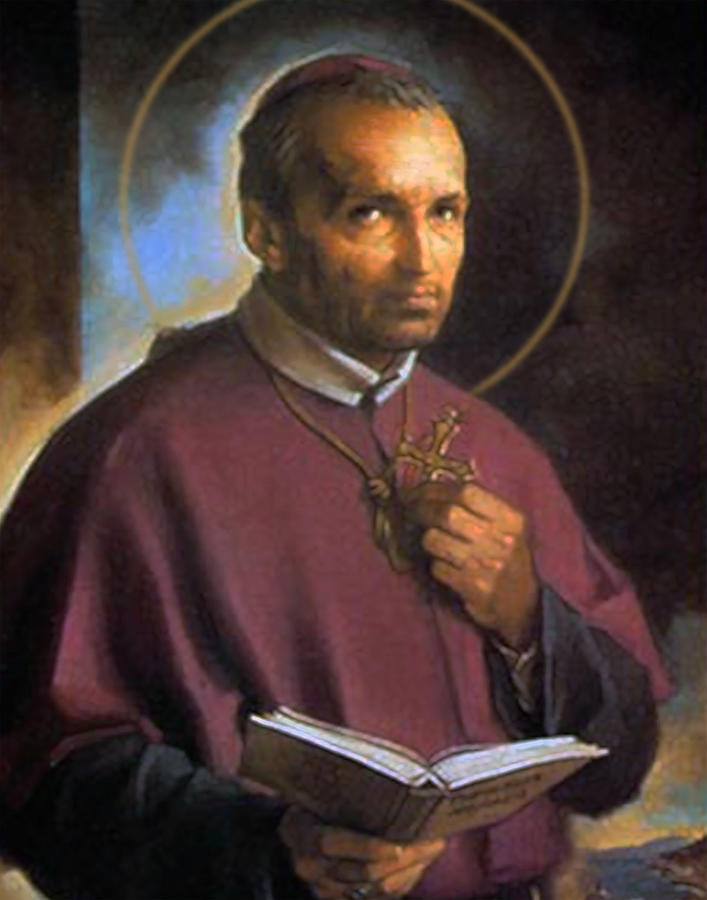
Alphonsus was born near Naples of a distinguished family. A brilliant youth, he won his doctorate of civil and church law when only 16, and then for several years engaged in a successful legal law practice. One day, however, when he was triumphantly defending a client in a lawsuit, it was shown to him that he had made an error in reading the law and had defended an unjust cause. He, therefore, not only gave up the case, he gave up his legal practice. Actually Alphonsus, though up to then a layman, had been lately attracted towards becoming a priest. He now took priestly studies and in 1726 was ordained. Then he began to work as a missionary throughout rural southern Italy. An able missionary he was, too. In an age in which it was stylish to preach bombastically, he could say, “I have never preached a sermon which the poorest old woman in the congregation could not understand.” In an age in which the errors of “Jansenism” demanded unreasonable strictness in moral behavior, Alphonsus preached common sense Christian morality. This was also the kind of moral doctrine that he wrote volumes about, for he was the greatest moral theologian of his age – a fact that would win him after canonization the title of “doctor of the church”.
While engaged in home missionary work as a diocesan priest, Alphonsus assisted in the foundation of the Redemptoristine nuns. A year or so later he established the Redemptorist Fathers as a missionary organization. When de’Liguori was sixty-six, Pope Clement XIII named him bishop of the diocese of Sant’ Agata dei Goti. He tried to get out of it, but the pope insisted. It was a small diocese, but needed reform very badly. Bishop de’Liguori gave it that reform. Meanwhile he was stricken with a rheumatic arthritis so severe that his chin was almost buried in his chest. He asked the pope permission to resign as bishop in 1775. By that time he had such a reputation for goodness and zeal that, as one churchman said of the man still alive, “If I were pope, I would canonize him without any process.”
If Alphonsus, on retiring, thought he could live out his life in peace, he was mistaken. Now began for this 80-year-old priest, his years of greatest trial – largely because of red tape. Naples was a separate kingdom in those days. King Charles III, a Bourbon, shared the idea of the Enlightenment that a King should keep close control over church affairs. Now he required that the Redemptorists, already approved by the Pope, be given state approval, too. But his policy would not allow him to approve any religious orders (these he considered old-fashioned and unprogressive), only societies of secular priests. Unfortunately, St. Alphonsus’s advisors just showed the saint the state regulations when they asked for his signature. Poor Bishop Alphonsus at that point could not read more than the initial words, because of failing eyesight. Thus he unwittingly approved of a law that the pope had to denounce. Pope Pius VI, therefore, declared that the Naples Redemptorists were no longer Redemptorists because they had changed the rule and that only those in the Roman province of the order were such. He named another priest, located in Rome, as Redemptorist general superior. Thus Alphonsus, the founder of the order, found himself demoted from office and his order abolished in the Kingdom of Naples.
In addition to this martyrdom to red tape, Alphonsus was at the same time suffering severe temptations against faith; yet these dark hours were intermittently lighted by hours of great prayerfulness and grace. More importantly, he accepted his double burden with supreme patience. In peace of soul, he foretold that the divided order would be reunited after his death. He died at 90. Three years later the Neapolitan Redemptorists were readmitted to membership; and in 1796 Pius VI, who had felt obliged to exclude Alphonsus from his order, introduced the cause for his canonization. Being a saint is not easy, you see! -- Father Robert F. McNamara
Scripture(Rom 8:1-4)
Now there is no condemnation for those who are in Christ Jesus. For the law of the spirit of life in Christ Jesus has freed you from the law of sin and death. For what the law, weakened by the flesh, was powerless to do, this God has done: by sending his own Son in the likeness of sinful flesh and for the sake of sin, he condemned sin in the flesh, so that the righteous decree of the law might be fulfilled in us, who live not according to the flesh but according to the spirit.
Writings
(Year A). Oh ! how often do we deceive ourselves by desiring to engage in certain undertakings in order to please ourselves without seeing that they are not conformable to the divine will. How often do we act through self-love, saying: But what I wish to do is conducive to the glory of God. But let us be persuaded that the greatest glory that we can give to God is to conform ourselves to his divine will. Since nothing is more dear to us than self-will, the sacrifice of it is the most acceptable offering we can present to the Lord. This is the sacrifice that God himself continually asks of us with so much earnestness. My son, give me thy heart. Son, give me your heart, that is, your will. Nothing else that we offer to God can content him as long as we reserve our own will. I explain myself by this example: If you had two servants, one of whom labored continually, but always according to his own will; the other performed less work, but was obedient to all your directions, - you would certainly entertain a great regard for the latter, and little or no esteem for the former. Ah ! happy the soul that can always say with the sacred Spouse: My soul melted when he spoke. My soul melted as soon as my beloved spoke. Why does she say melted? Listen: what is rendered liquid no longer retains its own shape, but takes the form of the vessel in which it is contained. Thus, loving souls do not retain their own wills, but conform them to whatever their beloved wills. This conformity implies a will docile and pliant in all things pleasing to God, compared with the obdurate will that resists the divine will. An instrument is said to be a good one when it is obedient to the person that employs it; if it refuse to obey, of what use is it ? For example, were a pencil to resist the hand of the painter, if, when drawn to the right, it should turn to the left; if. when drawn downwards, it should seek to move upwards, what would the painter do? Would he not instantly cast it into the fire? And let us be persuaded that whatever he does, he does for our good, and because he loves us. Many things appear to us to be misfortunes, and we call them misfortunes; but if we understood the end for which God sends them, we should see that they are graces. Oh, how great the peace of the soul whose will is in all things conformed to the will of God ! Because she wishes only what he wills, she always obtains whatsoever she desires; for all that happens in the world, happens by the will of God. (True Spouse of Jesus Christ)
Musical Selections
O bread of heaven beneath this veil Thou dost my very God conceal; my Jesus, dearest treasure, hail; I love Thee and adoring kneel; each loving soul by Thee is fed with Thine own self in form of bread.
O food of life, Thou Who dost give the pledge of immortality; I live; no, 'tis not I that live; God gives me life, God lives in me: He feeds my soul, He guides my ways, and every grief with joy repays.
O bond of love, that dost unite the servant to His living Lord; could I dare live, and not requite such love than death were meet reward: I cannot live unless to prove some love for such unmeasured love.
Beloved Lord in heaven above, there, Jesus, Thou awaitest me; to gaze on Thee with changeless love, yes, thus I hope, thus shall it be: for how can He deny me heaven Who here on earth Himself hath given?
You descend from the stars, O King of Heaven And come in a cave, with cold and chill. O my divine Child, I see you here shivering. O blessed God, How much it cost you to love me!
For you, the Creator of the World, Lacking clothes and fire, O my Lord. Dearest chosen one, How this poverty Makes me love you more, Since Love made you poor for us.
Collect
O God,
you never cease to renew your Church
with fresh examples of holiness;
give us the zeal for souls of the holy bishop Alphonsus,
that, walking in his footsteps,
we may come to share his reward in heaven.
We ask this through our Lord Jesus Christ, your Son,
who lives and reigns with you in the unity of the Holy Spirit,