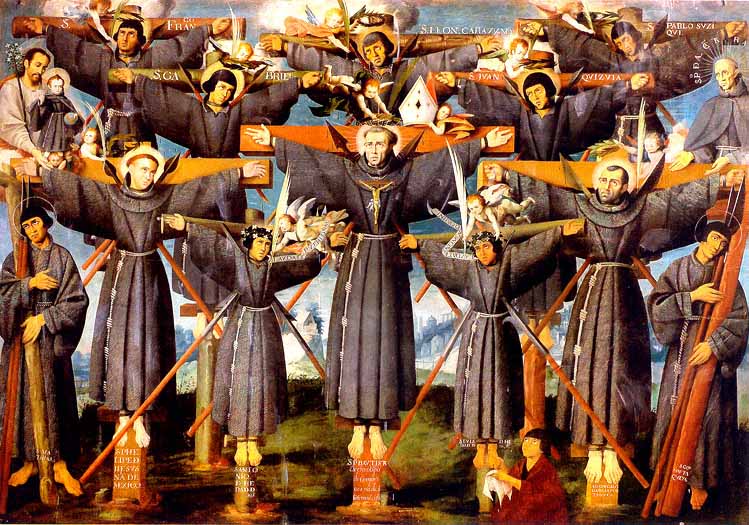
Japan, like China, has proved hard to win over to the Gospel. St. Francis Xavier first planted Christianity there in 1549, and it is said that by 1587 there were over 200,000 converts. But in 1588 the military leader Hideyoshi, who was the actual ruler under the shadow-emperor, ordered all Christian missionaries to depart. Some obeyed, but many stayed on in secret. In 1597 Hideyoshi apprehended 26 Christians, religious and lay. He had the left ears of 24 of them partly cut off, and then paraded them to Nagasaki through the villages, so as to frighten the spectators against having any more dealings with Christianity.
This group of “elect” included a cross section of Japanese Catholicism: four Spanish Franciscans; a Franciscan born in Bombay, and of Portuguese or possibly Indian background; and a native of Mexico (Friar Philip de las Casas, not yet ordained to the priesthood). There were three Japanese Jesuits, Father Paul Miki and two laybrothers. The remainder were Japanese: a soldier, a physician; two carpenters; three altarboys - teenagers; a cook, etc. All stood firm in their faith.
When the “show-victims” had reached Nagasaki, they were allowed to make their confessions to two Jesuits. Then they were chained to wooden crosses on Nishizaka Hill with iron collars around their necks. The crosses were next lifted and placed in holes already dug. A soldier with a lance was stationed by each victim. At a given signal, each soldier plunged his spear into the heart of the assigned victim, and it was quickly over.
Many Christians were among the bystanders, for the government’s intention was not to destroy Christians but Christianity. These Catholics collected the blood and clothing of the martyrs as treasured relics, and soon ascribed miracles to them. Pope Pius IX canonized the 26 in 1862. Their feastday is February 6.
The martyrdom of St. Paul Miki and the other 25 marked only a beginning of persecution. Eventually between 1622 and 1632, a great number received the martyr’s crown: some beheaded, some burnt alive, some buried alive, some allowed to die in prison or in exile out of willful neglect. Again, they represented a wide swath of Japanese society. Many died, among them small children, simply because of the Japanese practice of killing off the whole family of any condemned person. Two hundred and five of the later martyrs were beatified by Pope Pius IX on May 7, 1867. The “Blessed Martyrs of Japan” are venerated on two feast days, June 1 and September 10.
The heroic Japanese Catholics who have been declared saints or blesseds represent only a small percentage of the nation’s martyrs. Historians debate the exact number of those Catholics who have suffered for the faith in Japan. At least 4000 certainly qualify as martyrs in the technical sense. Estimates of the rest are as high as 35,000, if not more. However, most of them remain nameless. Even those who were not executed often suffered by the thousands from robbery, exile, prison and torture. It was a terrible exemplification of man’s cold inhumanity to man.
“The blood of martyrs is a seed,” a prominent church writer declared during the Roman persecutions. The truth of this adage has often been verified in other nations, but not yet in Japan. However, to judge by the Catholic martyrs Japan has produced, the Japanese have the makings of extraordinary Christians. May our prayers water their harsh spiritual soil so as to produce, at length, an abundant harvest of souls. --Father Robert F. McNamara
Our brother, Paul Miki, saw himself standing now in the noblest pulpit he had ever filled. To his “congregation” he began by proclaiming himself a Japanese and a Jesuit. He was dying for the Gospel he preached. He gave thanks to God for this wonderful blessing and he ended his “sermon” with these words: “As I come to this supreme moment of my life, I am sure none of you would suppose I want to deceive you. And so I tell you plainly: there is no way to be saved except the Christian way. My religion teaches me to pardon my enemies and all who have offended me. I do gladly pardon the Emperor and all who have sought my death. I beg them to seek baptism and be Christians themselves”.
Then he looked at his comrades and began to encourage them in their final struggle. Joy glowed in all their faces, and in Louis’ most of all. When a Christian in the crowd cried out to him that he would soon be in heaven, his hands, his whole body strained upward with such joy that every eye was fixed on him.
Anthony, hanging at Louis’ side, looked toward heaven and called upon the holy names – “Jesus, Mary!” He began to sing a psalm: “Praise the Lord, you children!” (He learned it in catechism class in Nagasaki. They take care there to teach the children some psalms to help them learn their catechism).
Others kept repeating “Jesus, Mary!” Their faces were serene. Some of them even took to urging the people standing by to live worthy Christian lives. In these and other ways they showed their readiness to die.
Then, according to Japanese custom, the four executioners began to unsheathe their spears. At this dreadful sight, all the Christians cried out, “Jesus, Mary!” And the storm of anguished weeping then rose to batter the very skies. The executioners killed them one by one. One thrust of the spear, then a second blow. It was over in a very short time. (Anonymous eyewitness account)
Musical Selection (sung from their crosses prior to their execution)
who enriched the Church in Japan
with the blood of martyrs who bore witness to Christ
through their suffering on the cross:
grant that we may learn from their example
to place nothing before our service of your kingdom,
in which Jesus Christ is alive and reigns with you,
in the unity of the Holy Spirit,
God, now and for ever. Amen. (English Missal)