Introit
Collect
O God, who through your Word
reconcile the human race to yourself in a wonderful way,
grant, we pray,
that with prompt devotion and eager faith
the Christian people may hasten
toward the solemn celebrations to come.
Through our Lord Jesus Christ, your Son,
who lives and reigns with you in the unity of the Holy Spirit,
one God, for ever and ever. Amen.
First Reading 1 Samuel 16:1b, 6-7, 10-13
The Lord said to Samuel, “Fill your horn with oil and set out; I will send you to Jesse of Bethlehem, for I have provided for myself a king among his sons.” 6 When the sons of Jesse came, Samuel looked on Eliab and thought, “Surely the Lord’s anointed is now before the Lord.” 7 But the Lord said to Samuel, “Do not look on his appearance or on the height of his stature, because I have rejected him; for the Lord does not see as mortals see; they look on the outward appearance, but the Lord looks on the heart.” 10 Jesse made seven of his sons pass before Samuel, and Samuel said to Jesse, “The Lord has not chosen any of these.” 11 Samuel said to Jesse, “Are all your sons here?” And he said, “There remains yet the youngest, but he is keeping the sheep.” And Samuel said to Jesse, “Send and bring him; for we will not sit down until he comes here.” 12 Jesse sent and brought David in. Now he was ruddy, and had beautiful eyes, and was handsome. The Lord said, “Rise and anoint him; for this is the one.” 13 Then Samuel took the horn of oil, and anointed him in the presence of his brothers; and the spirit of the Lord came mightily upon David from that day forward.
Responsorial Psalm (Ps 23:1-3a,3b-4,5,6)
R. The Lord is my shepherd; there is nothing I shall want.
Second Reading Ephesians 5:8-14
Once you were darkness, but now in the Lord you are light. Live as children of light— 9 for the fruit of the light is found in all that is good and right and true. 10 Try to find out what is pleasing to the Lord. 11 Take no part in the unfruitful works of darkness, but instead expose them. 12 For it is shameful even to mention what such people do secretly; 13 but everything exposed by the light becomes visible, 14 for everything that becomes visible is light. Therefore it is said, “Sleeper, awake! Rise from the dead, and Christ will shine on you.”
Verse Before The Gospel (Jn 8:12)
Gospel John 9:1, 6-9, 13-17, 34-38
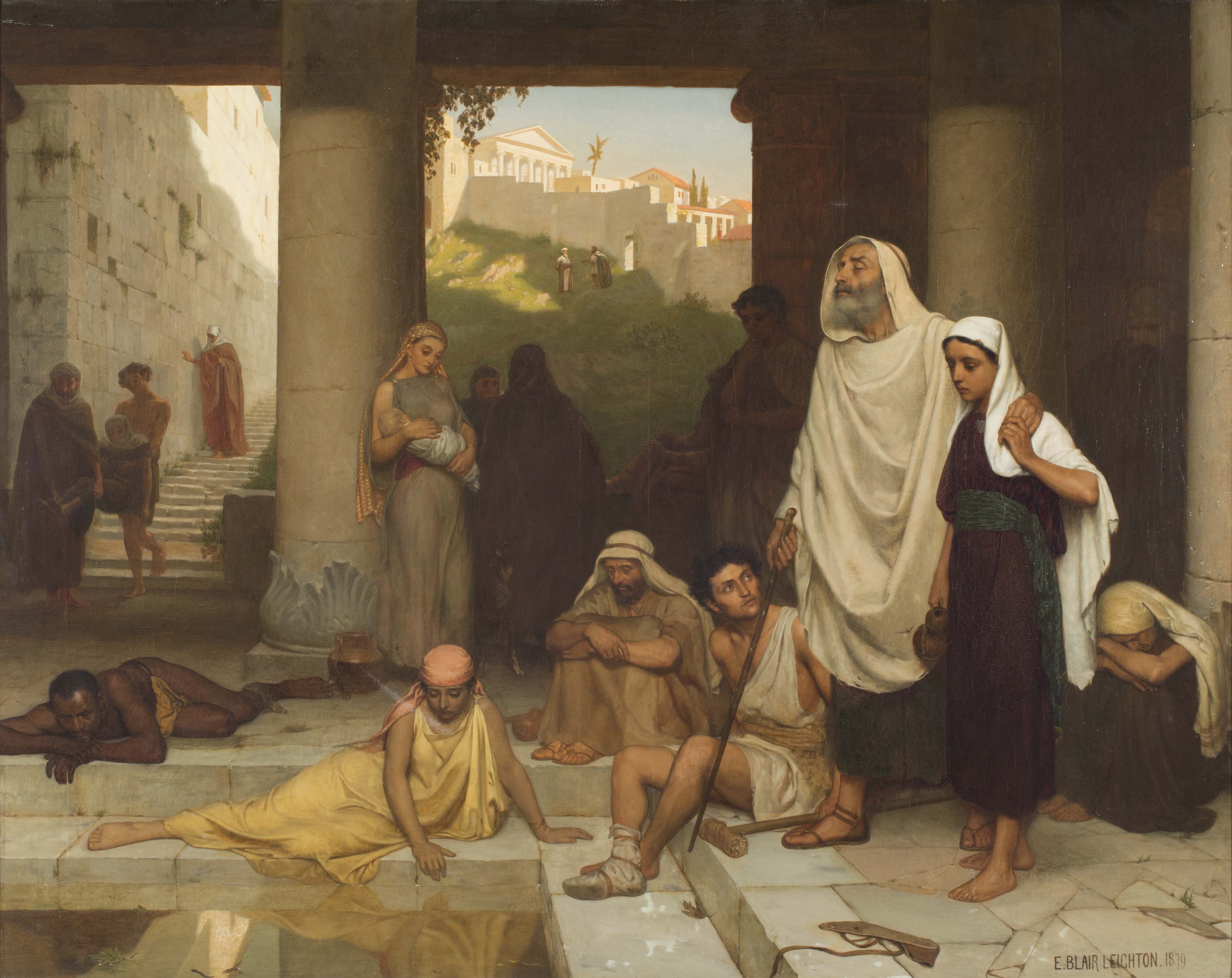
As Jesus walked along, he saw a man blind from birth. 6 He spat on the ground and made mud with the saliva and spread the mud on the man’s eyes, 7 saying to him, “Go, wash in the pool of Siloam” (which means Sent). Then the man who was blind went and washed, and came back able to see. 8 The neighbours and those who had seen him before as a beggar began to ask, “Is this not the man who used to sit and beg?” 9 Some were saying, “It is he.” Others were saying, “No, but it is someone like him.” He kept saying, “I am the man.” 13 They brought to the Pharisees the man who had formerly been blind. 14 Now it was a sabbath day when Jesus made the mud and opened his eyes. 15 Then the Pharisees also began to ask him how he had received his sight. He said to them, “He put mud on my eyes. Then I washed, and now I see.” 16 Some of the Pharisees said, “This man is not from God, for he does not observe the sabbath.” But others said, “How can a man who is a sinner perform such signs?” And they were divided. 17 So they said again to the blind man, “What do you say about him? It was your eyes he opened.” He said, “He is a prophet.” 34 They answered him, “You were born entirely in sins, and are you trying to teach us?” And they drove him out. 35 Jesus heard that they had driven him out, and when he found him, he said, Do you believe in the Son of Man?” 36 He answered, “And who is he, sir? Tell me, so that I may believe in him.” 37 Jesus said to him, “You have seen him, and the one speaking with you is he.” 38 He said, “Lord, I believe.” And he worshipped him.
Catena Nova
I was in the world like someone blind and as though without God, since I did not know my God. Then You, in person, pitied me and looked upon me, when You shone Your Light into my darkness, You converted me and drew me to Yourself, O my Creator. And when You had snatched me out of the depths of the pit …of this life’s pleasures and desires, then You showed me the way and gave me a guide who would lead me to Your commandments. I followed him, followed him without a care … but not only that, when I saw You there – You my Good Master – together with my guide and my Father, I experienced inexpressible love and desire. I was beyond faith, beyond hope and said: “Now indeed I see the good things to come” (cf. Heb 10:1), the Kingdom of Heaven is there. I saw before my eyes those things “that eye has not seen nor ear heard”(Is 64:3; 1 Co 2:9).” (St. Simeon the New Theologian)
All you souls devoted to God, run with intense desire to this fountain of life and light, and cry out to him with all the power of your hearts: “O inaccessible Beauty of God most high, purest Clarity of the Eternal Light, Life imparting life to every life, Light imparting light to every light, keeping in eternal brilliance a thousand times a thousand lamps that brightly shine ever since the primeval dawn! O eternal and inaccessible, clear and sweet Stream from the Fountain invisible to all mortal eyes: your depth knows no bottom, your width knows no shore, your vastness no bounds, your clearness no taint!”…. quench with the longed-for waters of this torrent the thirst of our burning hearts, so that, amid loud cries of joy and thanksgiving, we may sing to you a canticle of praise and learn by experience that with you is the fountain of life, and in your light we see light. (Saint Bonaventure)
That our Easter festival should fall during the first weeks of spring is certainly no accident. Today, this third Sunday before Easter, is the Church’s springtime festival. All people stand in wonder before the yearly miracle of spring, but we Christians have especial cause for wonderment and awe. For us, nature is the symbol of a fairer springtime, the springtime of grace in the kingdom of our God. Grace has filled our souls, and the death, the night, the cold of winter is passed. Woodlands and meadows are gay with the blossoms of spring; the air is vibrant with the song of the bird; and in this mirror of nature we see the reflection of a higher life still, the life of grace within our souls. Spring follows winter in unfailing succession; so too we are conscious that God has raised our fallen nature from its dreary winter sleep to the springtime of grace. We cannot believe in the eternal wickedness of the human heart. The joy of spring must return, and goodness, love, peace and grace once more blossom in our hearts. Nowhere could we find a fairer image of this transition from original sin to grace. Each year confronts us with the miracle of spring; each year, then, let us look into this mirror and see the greater miracle that God works in our souls: the miracle of grace. (Pius Parsch)
The name of the pool points to the mystical character of this water. It is called Missus, the one sent. Christ himself, the Messiah whom the Father has sent, is the pool, as he is the living water which fills the well of his Church; his blood poured out on the cross is the healing water for man, made sick and blind through sin. The death of Christ is his baptism for the forgiveness of sin and the illumination of his mind. It gives health and light, purity from sin, and faith. “I went and washed and saw, and I found faith in God” is the joyful speech of the man born blind in the sin of Adam and now healed…. The Church could not express more immediately or spontaneously her deep belief in the presence of the saving action of the new creation, when she celebrates the Mass…. Christ is present, he holds the earth which heals in his hand: it is his sacred flesh, his human, earthly body. The mysterious pool of Siloe is represented by the chalice, with its precious water and blood from the wound in the side of the crucified. Everything is ready for healing and for illumination. And we who were born blind are there. Baptism has indeed given us sight. (Aemiliana Löhr)
Homily
So what can we do to clear the air? "Knowing your own darkness," says Jung, "is the best method for dealing with the darknesses of other people…by making the darkness conscious …. Your vision will become clear only when you can look into your own heart. (Letters, Vol 1). We need, in other words, to own our projections. When that happens we are no longer blind, Jung adds, but “[know] that whatever is wrong in the world is in [ourselves], and if [we] only [learn] to deal with [our] own shadow [we have] done something real for the world. [We have] succeeded in shouldering at least an infinitesimal part of the gigantic, unsolved social problems of our day. . .How can anyone see straight when [they do not ] even see [themselves] and the darkness [they] unconsciously [carry] with [them] into all [their] dealings?” (Psychology and Religion: West and East).
Of course, none of this is easy. "No one," Jung warns, "can become conscious of the shadow without considerable moral effort. To become conscious of it involves recognizing the dark aspects of the personality as present and real. This act is the essential condition for any kind of self-knowledge" (CW 9ii; Aion) and "to penetrate the darkness we must summon all the powers of enlightenment that consciousness can offer" (CW 8; “The Stages of Life").
[Pastoral note from The Interpretation of the Bible in the Church; Pontifical Biblical Commission; April 23, 1996, D3:
Psychology and, in a somewhat different way, psychoanalysis have led, in particular, to a new understanding of symbol. The language of symbol makes provision for the expression of areas of religious experience that are not accessible to purely conceptual reasoning but which have a genuine value for the expression of truth. For this reason, interdisciplinary study conducted in common by exegetes and psychologists or psychoanalysts offers particular advantages, especially when objectively grounded and confirmed by pastoral experience.
Numerous examples could be cited showing the necessity of a collaborative effort on the part of exegetes and psychologists: to ascertain the meaning of cultic ritual, of sacrifice, of bans, to explain the use of imagery in biblical language, the metaphorical significance of miracle stories, the wellsprings of apocalyptic visual and auditory experiences. It is not simply a matter of describing the symbolic language of the Bible but of grasping how it functions with respect to the revelation of mystery and the issuing of challenge--where the "numinous" reality of God enters into contact with the human person.]
Intercessions
For the Church: that we may share the light of the Gospel with all who are struggling to recognize good from evil, truth from lies, and selfless love from self-serving activity.
For a spirit of respect: that we may honor each person who enters our life, particularly those with physical limitations, and encourage them to use their gifts and enrich the community.
For all who are bound by the blindness of prejudice: that God will free them judging others and open their eyes to the value and dignity of each human person.
For government officials: that God will anoint their minds and hearts so that they may promote the well-being of all whom they serve, particularly the vulnerable and powerless of society.
For all who have no sight or who losing their sight: that they may experience God’s presence with them and God’s guidance in living their lives fully.
For insight and openness to caring for our environment: that God will help us to see the damages that have been done to our air, water, and land, and guide us in developing policies that will protect the environment from further harm.
For all whose lives are darkened by alcohol, drugs, or pornography: that the light of the Gospel may shatter their darkness and open a path to living a new life.
For all who live in the darkness of violence, warfare, or human trafficking: that God will comfort all who are in pain, bring light into their lives, and speed the assistance that they need to find new communities.
God our Creator, show forth your mighty works in the midst of your people. Enlighten your Church, that we may know your Son as the true light of the world and through our worship confess him as Christ and Lord, who lives and reigns with you in the unity of the Holy Spirit, holy and mighty God for ever and ever. Amen. (ICEL; 1998)
Offertory Antiphon
Offertory Hymn
In your merciful loving kindness, you took flesh for us O Christ our God. You gave light to a man who from his mother's womb lived in darkness. How boundless is your compassion! You anointed his eyes with the mud your fingers had molded and made him worthy to be flooded with light divine! So now enlighten us O Giver of light; illumine the eyes of our hearts, for you alone are the Fountain of grace!
Communion Antiphon
Concluding Hymn (Rumi)