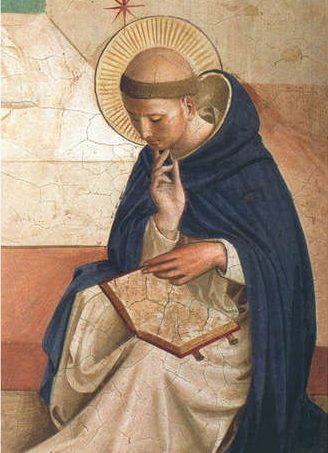
As founder of the Dominican order, the Spaniard St. Dominic ranks with the Italian St. Francis of Assisi among the charismatic reformers of the 13th century.
Dominic (surname de Guzman) was a native of Calaroga, Spain. His folks were noted for their dedication to the Church. Dominic studied for the priesthood and was named one of the official “chapter of canons” of the cathedral of Osma. From the start, his was a life of constant study, prayer, and priestly labor.
In 1204, Canon de Guzman went on an assignment that would broaden his horizons. Alfonso IX of Castile sent Bishop Diego of Osma to Denmark to arrange for a wedding between Alfonso’s son and a Danish princess. Diego took Dominic with him. Passage through southern France brought the pair into their first contact with the great number of Albigensian heretics who lived there. These were Catholics who had lately become infected with Manicheism. Manicheism was an ancient Mideast religion that saw the world as a battleground between two opposing principles, good and evil. They associated this evil with all material things, and the good with spiritual things alone. Thus they denied the incarnation and death of Christ, because they said God would never assume a detestable human body. On the same basis, they rejected the Christian sacraments. Salvation, they said, could be acquired only by fasting from food and drink and abstaining from marriage, so as not to further populate the world with fleshly human beings. Indeed, suicide was commendable as a sign of disdain of the flesh.
How could Catholics have been taken in by this morbid error? Dominic saw two main reasons: 1. They had never been properly educated in the Catholic faith. 2. The heretical leaders, with their detachment and poverty, seemed more “Christian” in their lives than the self-indulgent Catholic clergy. Therefore Dominic gathered a team of preachers and spent ten years preaching true doctrine in France, and carefully setting the best possible Christian good example. Like “hounds of God,” they pursued their campaign, winning many back to the truth.
His success having proved his diagnosis, Dominic now founded a religious order called the “Order of Preachers,” but popularly known as the Dominicans. Its chief mission was to educate by preaching (and for this his friars had to be constantly studying their theology). Just as important was his stress on the poverty and humility of his Dominicans. He had practically experienced what St. Jerome once wrote, “Your deeds are more credible than your words.” (It was in connection with founding this order that Dominic met and was inspired by St. Francis of Assisi.)
Because of his insistence on scholarship, the Order of Preachers spread rapidly to European learned centers, like the Universities of Paris and Bologna. They soon produced such savants as St. Thomas Aquinas and St. Albert the Great. By 1221 the Dominicans were represented in Palestine, Poland, France, Spain, Hungary, Scandinavia, and England. Eventually they would spread to the New World. Dominic also founded a women’s Dominican branch and a third order that welcomed laity. They established many charitable institutes and influenced popular piety, especially by promoting the recitation of the rosary. Today, the friars alone have 6800 members.
Dominic was clearly a genius as well as a saint, an organizer as well as a mystic. Thrice offered a bishopric, he thrice declined. He felt that his educational task was his true calling. Although barely 50 when he died, his movement still runs strong. One of his secrets of success was an inborn sense of personal concern for others. “Nothing”, wrote his biographer, “disturbed the even temper of his soul except his quick sympathy for every sort of suffering, and as a man’s face shows whether his heart is happy or not, it was easy to see from his friendly and joyous countenance that he was at peace inwardly. With his unfailing gentleness and readiness to help, no one could ever despise his radiant nature, which won all who met him and made him attract people from the first.”
When his friend Pope Gregory IX prepared to canonize him in 1234, he declared that he was as sure of the holiness of Dominic as he was of that of Ss. Peter and Paul! -- Father Robert F. McNamara
Scripture (I Cor. 2:1-10a)
(Year A). THE deeds and aspirations of Dominic in his apostolic labors and in the foundation of the Preachers represent him fully enough to enable us to know him and portray him; moreover, we have numerous views of his character from those who lived and labored with him. The depositions during the process of canonization at Bologna and at Toulouse leave nothing to be desired in this regard. In their clear, short, and precise testimony, the witnesses engrave in perfect harmony all the lines which compose the moral and religious features of the Founder of the Preachers. One of his religious daughters, Cecilia Cesarini, to whom the saint gave the habit of the Order at St. Sixtus, has traced a detailed word-portrait of her spiritual father: "The Blessed Dominic was of medium height and of slight build. His countenance was beautiful, of fair complexion, with light auburn hair and beard and luminous eyes. A kind of radiance shone from his brow, inspiring love and reverence in all. Full of joy, he seemed ever ready to smile, unless moved to pity by the affliction of his neighbor. His hands were long and shapely; his voice strong, noble, and sonorous. He never was bald, and his corona was complete, sprinkled with a few white hairs." Dominic, no doubt, would have smiled at this description of him: "Cecilia," he would say, "there is only one beauty: that of the soul." Rarely have nature and grace apportioned their gifts so generously as to Dominic, and rarely has a man been as faithful in cultivating the seed sown by Providence. His constant effort was to develop the growth to perfection. Born to be a leader and guide of souls, never did he forget the great principle that gives power to authority: act by force of example and do more yourself than you ask of others. The Church had placed him at the head of a militia of "invincible athletes of Christ," her own earliest name for them. The head of these athletes of the faith had to be himself a model of athletes, an apostle par excellence, powerful in word and work. Faith and charity animated the whole career of Dominic in his personal life and in his public activity. These divine talents cultivated his natural gifts and made them fruitful; for he esteemed these goods as coming also from God. Viewing them constantly vitalized by grace, we, too, can appreciate and admire their native splendor. Dominic had a nature of exquisite sensibility and profound force. Those who knew him and lived intimately with him emphasize equally his spirit of joy and his flow of tears at the sight of suffering. He was one of those generous souls that live only for others; hence his gift for compassion and consolation. Without effort he communicated the spirit of his own soul to the soul of his neighbor. Dominic guarded perpetual virginity. The spiritualized character imposed upon their senses by souls that submit neither to the tyranny nor to the caprice of the flesh, had refined his sensibilities and purified his affections. To maintain a continual mastery over his body, the Founder of the Preachers followed a program of extreme rigor. Watching, fasting, mortifications of every kind along with the privation and fatigue of long journeys on foot had made a supple instrument of a servant so rebellious as is the flesh of man. Nor is it surprising that a soul like Dominic's, at once gentle, strong, and ardent, radiated its inner strength through such feeble and transparent clay without loss or diminution. (Pierre Mandonnet, St. Dominic and His Work)
Musical Selection
Collect
whose servant Dominic grew in the knowledge of your truth
and formed an order of preachers to proclaim the faith of Christ:
by your grace give to all your people a love for your word
and a longing to share the gospel,
so that the whole world may come to know you and your Son
Jesus Christ our Lord,
who lives and reigns with you,
in the unity of the Holy Spirit,
God, now and for ever. Amen. (New English Missal)