Life (+1794)
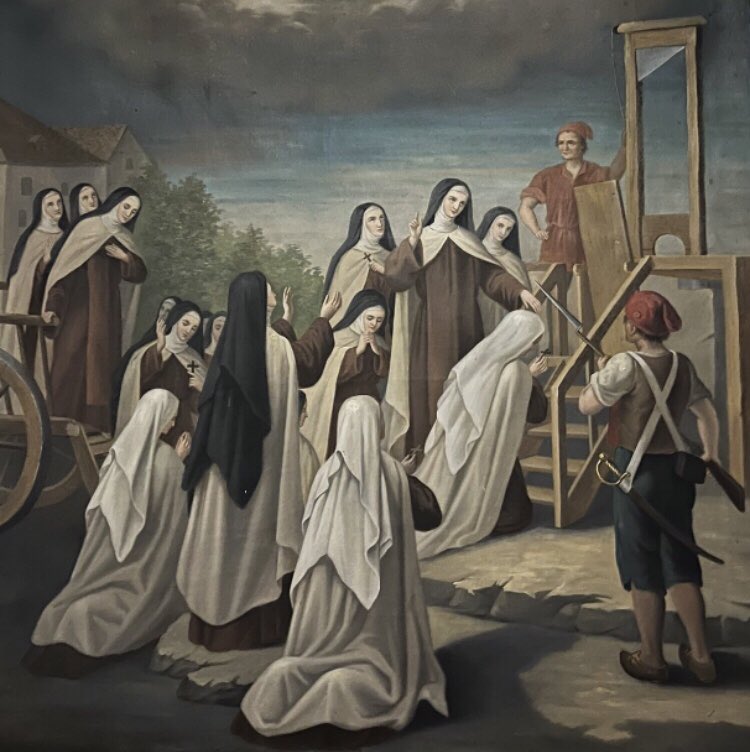
A community of 16 Carmelite nuns from Compiègne, Mother Teresa of St Augustine and Companions, were executed on 17 July 1794 during the French Revolution.
The Sisters had refused to comply with the Civil Constitution of the Clergy, a law passed in 1790, which subordinated the Catholic Church to the revolutionary government, confiscated all Church land and banned religious orders. The Carmelites of Compiègne resisted the suppression of their monastery and so were arrested in June 1794 and imprisoned at the former Visitation convent of Compiègne, where they offered themselves daily for the peace of France and the Church. On 17 July they were tried in Paris, convicted of treason and sentenced to death by guillotine. Providentially, they were wearing their outlawed religious habits, since their only secular clothes were being washed on the day of the trial.
The Sisters were then transported in tumbrels among a group of 40 condemned prisoners to the place of execution at the Place du Trône, Paris. On the journey, the Sisters chanted the combined Offices of Vespers and Compline. This included the Miserere, the penitential Psalm 50: “Have mercy on me, O God, in your kindness…” and concluded with the Salve Regina. Eyewitness accounts report that the usually hostile crowds along the route were strangely silent.
On reaching the place of execution, Mother Teresa intoned the Te Deum, and then Veni Creator Spiritus. Then all of the Sisters renewed their vows and Sr Constance, the youngest and still a novice, joined in, thus making Profession before mounting the scaffold. Sr Constance was the first to die, after kneeling for the blessing of her Prioress, and kissing a small staute of Our Lady. As she approached the guillotine, she intoned Laudate Dominum Omnes Gentes (Psalm 117) : “O praise the Lord, all you nations; acclaim him all you peoples. Strong is his love for us; he is faithful for ever.” This was taken up by all the Sisters, who continued to sing, with diminishing voices, until all had died. Usually executions were accompanied by shouting and cheers but there was only silence.
Sr Constance waved aside the executioner and his two assistants and approached the guillotine unaided. It is likely that the executions continued in order of religious profession. We know that Mother Teresa was the last. The 78 year old Sr Mary of Jesus Crucified was heard to say to the executioners “I forgive you, my friends. I forgive you with all that longing of heart with which I would that God forgive me!” The bodies of the Carmelites were buried in a Mass grave.
Many believe that the sacrifice of Mother Teresa of St Augustine and her community brought about the end of the ‘Reign of Terror’, which happened just 10 days later on 27thJuly 1794. Their story has captured the popular imagination, inspiring a novella by Gertrud von le Fort, a play by Georges Bernanos and an opera by Francis Poulenc. They were beatified by Pope St Pius X on 27 May 1906.
** In 2024 Pope Francis announced the equipollent canonization of Mother Teresa of St. Augustine and her 16 Discalced Carmelite companions.
Source: https://www.thicketpriorycarmel.org/blessed-martyrs-of-compiegne
Once you were alienated from God and were enemies in your minds because of your evil behavior. But now he has reconciled you by Christ’s physical body through death to present you holy in his sight, without blemish and free from accusation— if you continue in your faith, established and firm, and do not move from the hope held out in the gospel. This is the gospel that you heard and that has been proclaimed to every creature under heaven, and of which I, Paul, have become a servant. Now I rejoice in what I am suffering for you, and I fill up in my flesh what is still lacking in regard to Christ’s afflictions, for the sake of his body, which is the church.
Musical Selection (Ave Maria from Dialogues of the Carmelites)
Collect
Lord God,
you called St. Teresa of St. Augustine and her companions
to go on in the strength of the Holy Spirit from the heights of Carmel to receive a martyrs’ crown.
May our love too be so steadfast that it will bring us
to the everlasting vision of your glory.
We ask this through our Lord Jesus Christ, your Son,
who lives and reigns with you in the unity of the Holy Spirit,
God, for ever and ever. Amen. (Carmelite Sacramentary)