Introit
Collect
Almighty ever-living God,
whom, taught by the Holy Spirit,
we dare to call our Father,
bring, we pray, to perfection in our hearts
the spirit of adoption as your sons and daughters,
that we may merit to enter into the inheritance
which you have promised.
Through our Lord Jesus Christ, your Son,
who lives and reigns with you in the unity of the Holy Spirit,
God, for ever and ever. Amen.
First Reading (1 Kgs 19:9a, 11-13a)
When Elijah reached Horeb, the mountain of God, 9 he came to a cave, and spent the night there. Then the word of the Lord came to him, saying, 11 “Go out and stand on the mountain before the Lord, for the Lord is about to pass by.” Now there was a great wind, so strong that it was splitting mountains and breaking rocks in pieces before the Lord, but the Lord was not in the wind; and after the wind an earthquake, but the Lord was not in the earthquake; 12 and after the earthquake a fire, but the Lord was not in the fire; and after the fire a sound of sheer silence. 13 When Elijah heard it, he wrapped his face in his mantle and went out and stood at the entrance of the cave.
Responsorial Psalm (Ps 85:9,10,11-12,13-14)
R. Lord, let us see your kindness, and grant us your salvation.
Second Reading (Rom 9:1-5)
I am speaking the truth in Christ. I am not lying; my conscience confirms it by the Holy Spirit. 2 I have great sorrow and unceasing anguish in my heart. 3 For I could wish that I myself were accursed and cut off from Christ for the sake of my own people, my kindred according to the flesh. 4 They are Israelites, and to them belong the adoption, the glory, the covenants, the giving of the law, the worship, and the promises; 5 to them belong the patriarchs, and from them, according to the flesh, comes the Messiah, who is over all, God be blessed forever. Amen.
Gospel Acclamation (cf. Ps 130:5)
Gospel (Mt 14:22-33)
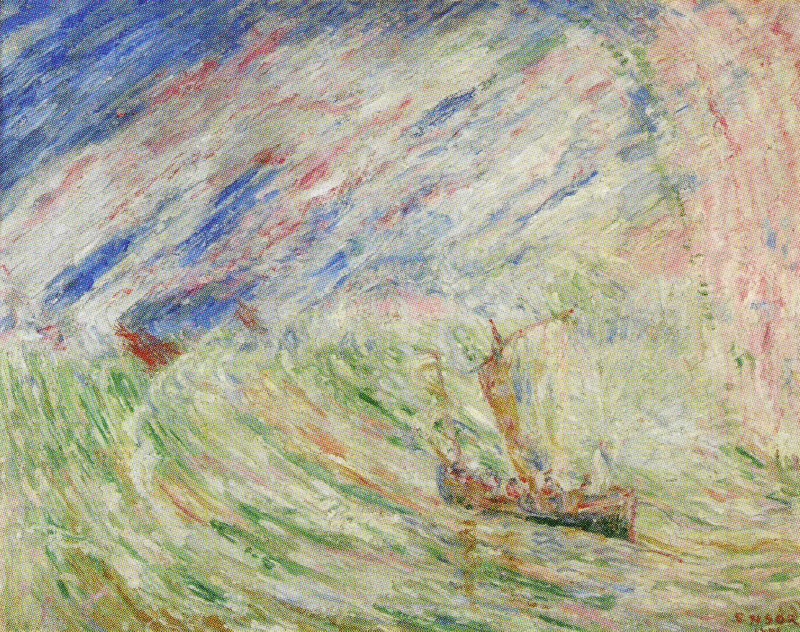
Immediately after feeding the crowd with the five loaves and two fish, 22 Jesus made the disciples get into the boat and go on ahead to the other side, while he dismissed the crowds. 23 And after he had dismissed the crowds, he went up the mountain by himself to pray. When evening came, he was there alone, 24 but by this time the boat, battered by the waves, was far from the land, for the wind was against them. 25 And early in the morning Jesus came walking toward them on the sea. 26 But when the disciples saw him walking on the sea, they were terrified, saying, “It is a ghost!” And they cried out in fear. 27 But immediately Jesus spoke to them and said, “Take heart, it is I; do not be afraid.” 28 Peter answered him, “Lord, if it is you, command me to come to you on the water.” 29 Jesus said, “Come.” So Peter got out of the boat, started walking on the water, and came toward Jesus. 30 But when he noticed the strong wind, he became frightened, and beginning to sink, he cried out, “Lord, save me!” 31 Jesus immediately reached out his hand and caught him, saying to him, “You of little faith, why did you doubt?” 32 When they got into the boat, the wind ceased. 33 And those in the boat worshipped him, saying, “Truly you are the Son of God.”
Catena Nova
Peter, ever volatile, always getting in before the other disciples, said: “Lord, if it is Thee, command me to come to Thee on the water” … He didn’t say, “Command me to walk on the water” but “come to thee,” for, there was none who loved Jesus as much as he.… Getting out of the boat, then, Peter went towards Jesus, more delighted to be going towards Him, than to be walking on the water. But after confronting the greatest danger, that of the sea, he was to give in to a lesser, that of the wind. Such is human nature! Often, having overcome serious dangers we are conquered by lesser ones … Peter had not yet been set free from all his fear … in spite of Christ’s presence beside him. For it is of no use to be beside Christ if one is not close to Him by faith. This is what emphasises the distance separating Master from the disciple …So if Peter’s faith had not faltered, he would have resisted the wind without difficulty. And the proof of this, is that Jesus grasped Peter ,while leaving the wind to continue blowing … Just as the mother bird supports the fledgling which has prematurely left the nest, with her wings, as it is about to fall and draws it back into the nest, so does Christ, with regard to Peter. (St John Chrysostom)
Think of this world as a sea, whipped up to tempestuous heights by violent winds. A person’s own private tempest will be his or her unruly desires. If you love God you will have power to walk upon the waters, and all the world’s swell and turmoil will remain beneath your feet. But if you love the world it will surely engulf you, for it always devours its lovers, never sustains them. If you feel your foot slipping beneath you, if you become a prey to doubt or realize that you are losing control, if, in a word, you begin to sink, say: “Lord, I am drowning, save me!” (St. Augustine).
Steer the ship of my life, Lord, to Your quiet harbour, where I can be safe from the storms of sin and conflict. Show me the course I should take. Renew in me the gift of discernment, so that I can see the right direction in which I should go. And give me the strength and the courage to choose the right course, even when the sea is rough and the waves are high, knowing that through enduring hardship and danger in Your name we shall find comfort and peace. Amen (St. Basil the Great).
The meaning of Holy Scripture reveals itself gradually to the higher senses of the more discerning mind when the mind has put off the complex bodily form of the words which are formed in it. This revelation is like a still small voice. Through a supreme abandonment of its natural activities, such a mind has been able to perceive the meaning only in a simplicity which reveals the divine Word. This is the way that the great Elijah was granted the vision in the cave at Horeb. For “Horeb” means “newness,” which is our virtuous condition in the new spirit of grace. The cave is the hiddenness of spiritual wisdom in which the one who enters will mystically experience the knowledge which goes beyond the senses. This is the knowledge in which God is found. Therefore anyone who truly seeks God, as did the great Elijah…. will also encounter him in the cave of Horeb – that is, as a contemplative in the hidden place of wisdom which can exist only in the habit of the virtues. When the mind shakes off the many distractions about things which are pressing on it, then the clear meaning of truth appears and gives it pledges of genuine knowledge.… For thoughts about the mere letter of Scripture and the consideration of those visible things that hinder understanding are indeed scales which cling to the clear-sighted part of the soul and hinder the passage to the pure meaning of truth (St. Maximus the Confessor).
You, O Eternal Trinity, are a deep sea into which, the more I enter, the more I find, and the more I find, the more I seek. O abyss, O eternal Godhead, O sea profound, what more could you give me than yourself? God’s grace, unsought and unearned, blows through my life, and all I need to do is raise my sails to catch the full wind.. (St. Catherine of Siena)
Homily
Intercessions (Joe Milner; The Sunday Web Site)
For the Church: that we may recognize God's presence in both the extraordinary and ordinary events of our lives so that we may cooperate with God more fully.
For the Jewish people, recipients of the promises and covenant, and bearers of great hardship: that they may ever deepen their relationship with God and remain faithful to the One who has called them.
For all who struggle with doubt and uncertainty: that they may find a path for growth and deeper faith.
For all who are recovering from the power of nature or other disasters: that God will give them courage, ease their pain, and speed the resources that they need.
For all who are experiencing the storms of daily life: that they may keep their eyes and attention on Jesus who strengthens us and calms our chaos.
For greater civility in public discourses: that all political leaders may show respect for their opponents, express their ideas and concerns thoughtfully, and work to promote the common good of society.
For all who are recovering from surgery: that God will relieve their suffering, speed their healing, and sustain them as they work to regain their strength.
God of all power, your sovereign word comes to us in Christ. When your Church is in danger, make firm our trust; when your people falter, steady our faith. Show us in Jesus your power to save, that we may always acclaim him as Lord, who lives and reigns with you in the unity of the Holy Spirit, God for ever and ever.
Offertory Antiphon
Offertory Anthem
In the night, Christ came walking
on the angry waves in the night, on the sea.
And Peter said, “Lord, if it be Thou,
Bid me come to Thee upon the waters”
(In the night, on the sea.)
And Jesus said “Come!”
And Peter walked on the sea.
But when he saw the waves, he was afraid,
and in fear lest he should perish, called:
“Lord, save me!”
(In the night, on the sea.)
And Jesus put forth His hand in the night
and rescued him from the sea.
Communion Antiphon
Closing Hymn