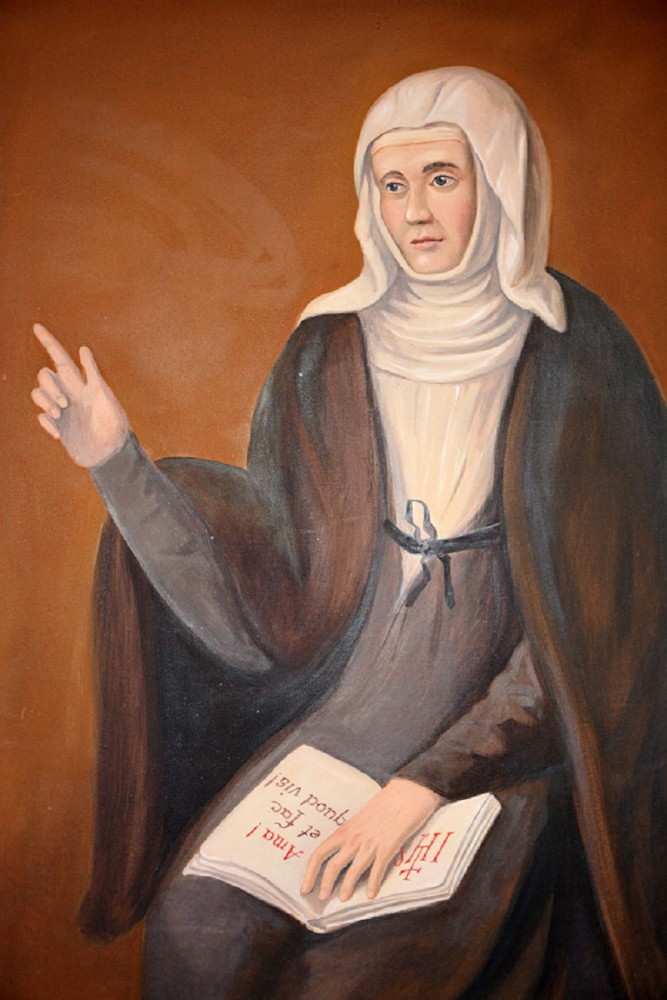
In our times, many orders of sisters have engaged in teaching. Before 1535, however, there was no religious order engaged in educational work. Nuns there were aplenty; but their role was seen as contemplative - cloistered away from the world and even from any active apostolate.
St. Angela Merici was responsible for changing all that, by organizing the Ursuline Sisters in 1535 for the education of women. Even in colonial times this order crossed the Atlantic. St. Marie of the Incarnation brought it to Quebec, Canada, in 1639. Another French group set up a convent in New Orleans in 1727 - the first convent of nuns in the present U.S.A. It was Ursulines who established the first Catholic women’s college in New York State: the College of New Rochelle (1904). Thus we owe to St. Angela the whole tradition of educational orders that has been so important to the American Church. And who was this pioneer teaching sister?
Angela Merici was a native of Desenzano in sub-Alpine Italy. The Merici parents trained her and her sister and brother in Christian living. Unfortunately, both parents died when Angela was only ten, so she and her sister were raised by an uncle who lived at Salo. At thirteen, Angela had a great emotional crisis. Her sister died suddenly without the last sacraments, and Angela worried greatly about the girl’s salvation. Finally, however, she was reassured in a vision - the first of many she would receive - that her sister had been saved. In her relief and gratitude, Angela now determined to dedicate her life to God’s service. She joined the Third Order of Franciscans and started to live a life of great austerity, in keeping with the old tradition of the saints.
Her uncle died when she was 22, so she returned to Desenzano. Here she became aware that many of the children were not receiving proper instruction in religion (as is so true in our own generation!). She gathered a few other women teachers and set up a school for girls. Under her capable direction, the group became successful and progressive teachers. Soon she was asked to open another school at Brescia. By now, she was not only training youngsters, but inspiring a number of prominent men and women of that worldly era to lead more Christian lives.
Angela’s own devotional life continued to develop. She was much given, for instance, to pilgrimages - that ancient and symbolic Catholic practice. She even made a pilgrimage to the Holy Land - a long, hard trip in those days. Furthermore, she became blind at Crete while en route. She spent all her time in Palestine without sight, but she was cured of her blindness on the return trip at the same place where she had lost it, on the island of Crete. Then in 1525, since it was a Holy Year of Jubilee, Angela went as a pilgrim to Rome to gain the great jubilee indulgence. When she had an audience with the Pope Clement VII, he tried to persuade her to stay at Rome and head a congregation of nursing sisters. But she was still convinced of her calling to education work. In fact, years before, she had experienced a vision in which she saw a group of young women ascending to heaven on a ladder of light. A voice had then said: “Take heed, Angela; before you die you will found at Brescia a company of maidens similar to those you have just seen. “ It was April 1533 that she made this prophecy come true. She chose a group of her companions for this work, and on November 25, 1535, they officially became the first Ursulines. Because they had to be an active order, they originally had no cloister, no special habit, no convents (they lived at home), and no formal vows; just a rule of poverty, chastity and obedience. In other words, they were organized much like today’s “secular institutes.”
After Angela’s death, their rule was somewhat altered. But she had brought into being one of the most innovative and effective organizations of the Catholic Reformation. While the Protestant reformers were destroying the Catholic faith of many adult Christians, Angela and her imitators were already raising in firm and knowing faith the girls that would mother the next generation of Catholics. --Father Robert F. McNamara
Scripture (1 Pt 4:7b-11)