December 18
1. First, why has not Rome been destroyed hitherto? How was it that the barbarians left it? Babylon sunk under the avenger whom GOD brought against it-Rome has not: why is this? for if there has been a something to procrastinate the vengeance due to Rome hitherto, peradventure that obstacle may act again and again, and stay the uplifted hand of divine wrath till the end come. The cause seems to be simply this, that when the barbarians came down, GOD had a people in that city. Babylon was a mere prison of the Church; Rome had received her as a guest. The Church dwelt in Rome, and while her children suffered in the heathen city from the barbarians, so again they were there the life and the salt of the city where they suffered.
Christians understood this at the time, and availed themselves of their position. They remembered Abraham's intercession for Sodom, and the gracious announcement made him, that had there been ten righteous men therein, it would have been saved.
When the city was worsted, threatened, and at length overthrown, the Pagans had cried out that Christianity was the cause of this. They said they had always flourished under their idols, and that these idols and devils (gods as they called them) were displeased at them for the numbers among them who had been converted to the faith of the Gospel, and had in consequence deserted them, given them over to their enemies, and brought vengeance upon them. On the other hand, they scoffed at the Christians, saying, in effect, "Where is now your GOD? Why does He not save you? You are not better off than we;"-like the impenitent thief, "If Thou be the CHRIST, save Thyself and us;" or, like the multitude, "If He be the SON of GOD, let Him come down from the Cross." This was during the time of one of the most celebrated bishops and doctors of the Church, St. Augustine; and he replied to their challenge. He replied to them, and to his brethren also, some of whom were offended and shocked that such calamities should have happened to a city which had become Christian. He pointed to the cities which had already sinned and been visited, and showed that they had altogether perished, whereas Rome was still preserved. Here then he said was the very fulfilment of the promise of GOD, announced to Abraham; for the sake of the Christians in it, Rome was chastised, not overthrown utterly.
Historical facts support St. Augustine's view of things: GOD showed visibly, not only provided secretly, that the Church should be the salvation of the city. The fierce conqueror, Alaric, who first came against it, exhorted his troops, "to respect the Churches of the Apostles St. Peter and St. Paul, as holy and inviolable sanctuaries;" and he gave orders that a quantity of plate consecrated to St. Peter should be removed into his Church from the place where it had been discovered.
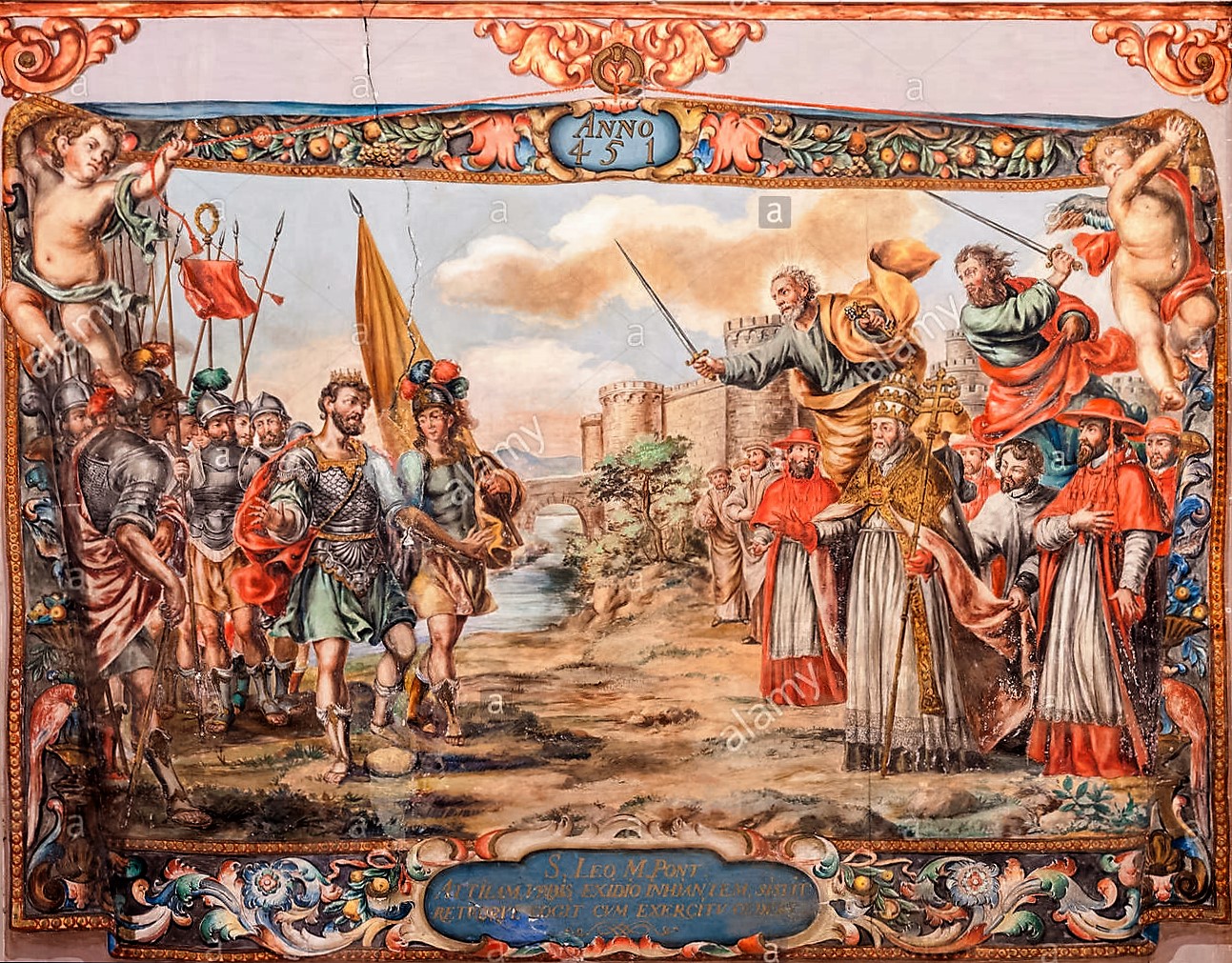
Again, fifty years afterwards, when Attila was advancing against the city, the bishop of Rome of the day, St. Leo, formed one of a deputation of three, who went out to meet him, and was successful in arresting his purpose. A few years afterwards, Genseric, the most savage of the barbarian conquerors, appeared before the defenceless city. The same fearless prelate went out to meet him at the head of his clergy, and though he did not avail to save the city from pillage, yet he gained a promise that the unresisting multitude should be spared, the buildings protected from fire, and the captives from torture.
Musical Selection (Lift Up Your Heads; Olaf C. Christiansen; lyrics in video)