Introit
Collect
Draw near to your servants, O Lord,
and answer their prayers with unceasing kindness,
that, for those who glory in you as their Creator and guide,
you may restore what you have created
and keep safe what you have restored.
Through our Lord Jesus Christ, your Son,
who lives and reigns with you in the unity of the Holy Spirit,
one God, for ever and ever. Amen.
First Reading (Is 55:1-3)
Thus says the LORD: All you who are thirsty, come to the water! You who have no money, come, receive grain and eat; Come, without paying and without cost, drink wine and milk! Why spend your money for what is not bread; your wages for what fails to satisfy? Heed me, and you shall eat well, you shall delight in rich fare. Come to me heedfully, listen, that you may have life. I will renew with you the everlasting covenant, the benefits assured to David.
Responsorial Psalm
R/. The hand of the Lord feeds us; he answers all our needs.
Second Reading (Rom 8:35,37-39)
Brothers and sisters: What will separate us from the love of Christ? Will anguish, or distress, or persecution, or famine, or nakedness, or peril, or the sword? No, in all these things we conquer overwhelmingly through him who loved us. For I am convinced that neither death, nor life, nor angels, nor principalities, nor present things, nor future things, nor powers, nor height, nor depth, nor any other creature will be able to separate us from the love of God in Christ Jesus our Lord.
Gospel Acclamation
Gospel (Mt 14:13-21)
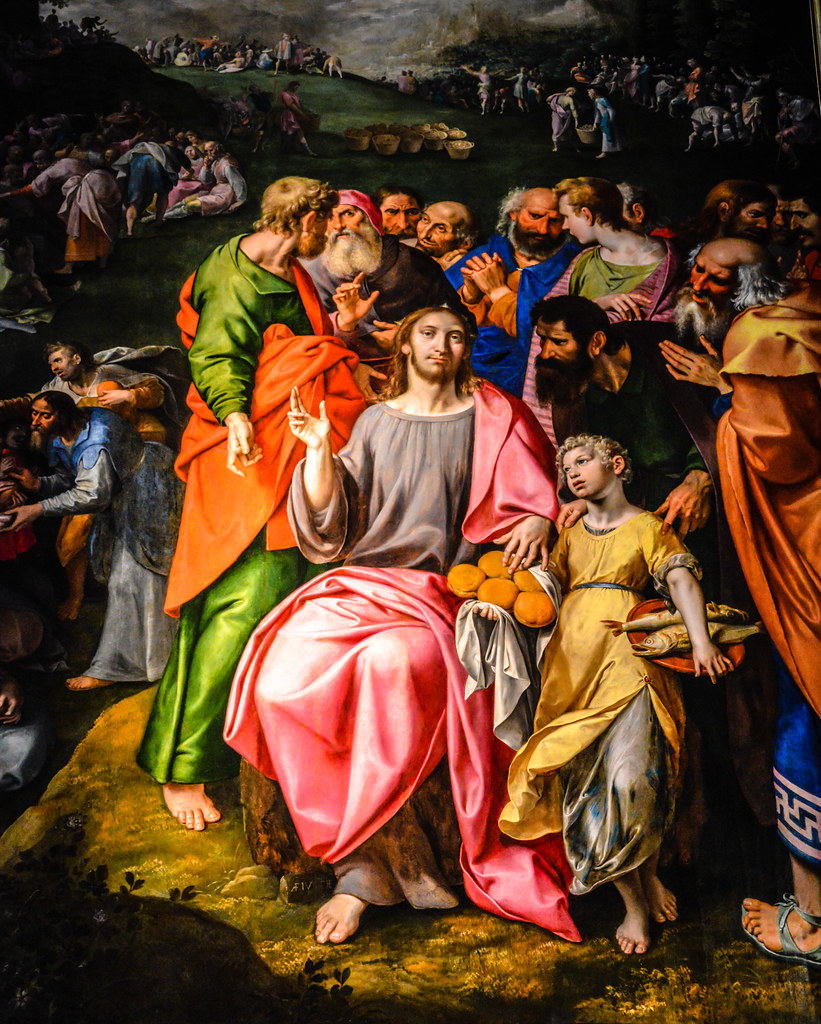
When Jesus heard of the death of John the Baptist, he withdrew in a boat to a deserted place by himself. The crowds heard of this and followed him on foot from their towns. When he disembarked and saw the vast crowd, his heart was moved with pity for them, and he cured their sick. When it was evening, the disciples approached him and said, “This is a deserted place and it is already late; dismiss the crowds so that they can go to the villages and buy food for themselves.” Jesus said to them, “There is no need for them to go away; give them some food yourselves.” But they said to him, “Five loaves and two fish are all we have here.”
Then he said, “Bring them here to me,” and he ordered the crowds to sit down on the grass. Taking the five loaves and the two fish, and looking up to heaven, he said the blessing, broke the loaves, and gave them to the disciples, who in turn gave them to the crowds. They all ate and were satisfied, and they picked up the fragments left over—twelve wicker baskets full. Those who ate were about five thousand men, not counting women and children.
Catena Nova
The five loaves signified the five books of Moses’ Law. The old Law is barley compared to the Gospel wheat. In those books are great mysteries concerning Christ contained. Whence He says, “If you had believed Moses, you would believe Me also; for he wrote of Me.” But as in barley the marrow is hid under the chaff, so in the veil of the mysteries of the Law is Christ hidden. As those mysteries of the Law are developed and unfolded; so too those loaves increased when they were broken. And in this that I have explained to you, I have broken bread unto you. The five thousand signify the people ordered under the five books of the Law. The twelve baskets are the twelve Apostles, who themselves too were filled with the fragments of the Law. The two fishes are either the two precepts of the love of God and our neighbor, or the two people of the circumcision and uncircumcision, or those two sacred personages of the king and the priest. As these things are explained, they are broken; when they are understood, they are eaten (St. Augustine).
“They that did eat were five thousand men, beside children and women,” which is an ambiguous expression; for either those who ate were five thousand men, and among those who ate there was no child or woman; or the men only were five thousand, the children and the women not being reckoned... Interpret with me allegorically the children in accordance with the passage, “I could not speak unto you as unto spiritual, but as unto carnal, as unto babes in Christ;” and the women in accordance with the saying, “I wish to present you all as a pure virgin to Christ;” and the men according to the saying, “When I am become a man I have put away childish things” (Origen).
Our Lord in a desert place changed a few loaves into many, and at Cana turned water into wine. Thus before the time came to give men and women his own body and blood to feed on, he accustomed their palates to his bread and wine, giving them a taste of transitory bread and wine to teach them to delight in his life-giving body and blood....He gave them things of little value for nothing to make them understand that his supreme gift would be given yet more freely.... Moreover, as well as giving freely he lovingly cajoled us, offering us these small things without charge to attract us and cause us to go and receive something greater and beyond all price. He awakened our desire by things pleasing to the palate in order to draw us to that which gives life to the soul. He gave a sweet taste to the wine he created to show how great is the treasure hidden in his life-giving blood (St. Ephrem the Syrian).
One of the greatest evils of the day among those outside the proximity of the suffering poor is their sense of futility. Young people say, “What good can one person do? What is the sense of our small effort?” They cannot see that we must lay one brick at a time, take one step at a time; we can be responsible only for the action of the present moment but we can beg for an increase of love in our hearts that will vitalize and transform all our individual actions, and know that God will take them and multiply them, as Jesus multiplied the loaves and fishes. The greatest challenge of the day is: how to bring about a revolution of the heart, a revolution which has to start with each one of us? When we begin to take the lowest place, to wash the feet of others, to love our brothers with that burning love, that passion, which led to the cross, then we can truly say, “Now I have begun” (Dorothy Day).
Homily
How? Because God provides in the midst of our weakness, our poverty, and our limitations. These, after all, are all we have. Five loaves and two fish. They’re the raw materials God uses to show forth his power at work in us who believe. We never have, then, a good reason to shrink from the heights God call us to, and settle for the downward pull of a fallen nature. No, the “little bit” we have is more than enough for God to transform and multiply.
So, come, all you who are thirsty,. . . come receive grain and eat; Come, without paying and without cost, drink wine . . . You shall eat well, you shall delight in rich fare (I). Come to this table, where we present our “little bit” of bread and wine, signs of our poverty, which God takes, and makes into the banquet of eternal life. Through Christ our Lord. Amen.
Intercessions
For the church, that neither death nor life, nor anguish, nor distress may keep us from conquering evil overwhelmingly because of the love of Christ Jesus our Lord.
That the Lord, who is just in all His ways and holy in all His deeds, may lift the minds and hearts of world leaders to the ways of integrity, life, and peace.
For all who feel powerless to help their brothers and sisters in need, that they may have the courage to bring to Jesus what little is available, so that His power to multiply may bless their efforts.
For all of us sharing this Eucharist, who come without paying to a divine banquet, that no fragment of this feast be lost, but shared freely with all who are in need of God.
For all who have asked for our prayers in a time of suffering, that our eyes may look hopefully to the Father on their behalf, and that He may open His hand and satisfy their desire for healing and strength.
For our beloved departed ones, that they may be brought into the banqueting hall of heaven and delight in the rich fare of the face to face vision of God.
Bountiful and compassionate God, you place in the hands of your disciples the food of life. Nourish us at your holy table, that we may bear Christ to others and share with them the gifts we have so richly received. We make our prayer through Christ our Lord. Amen.
Offertory Antiphon
Offertory Anthem
Who shall separate us from the love of Christ?
Shall tribulation, or distress or persecution,
or famine or nakedness or peril or the sword?
No, in these things we are more than conquerors
through him that loved us.
I am persuaded that death, nor life,
nor angels, nor height, nor depth,
nor any other creature shall be able to separate us
from the love of God, which is in Christ Jesus our Lord. Amen.
Communion Antiphon
Closing Hymn
Bread for the world
A world of hunger
Wine for all peoples
People who thirst
May we who eat
Be bread for others
May we who drink
Pour out our love
Lord Jesus Christ
You are the bread of life
Broken to reach
And heal the wounds
Of human pain
Where we divide your people
You are waiting there
On bended knee
To wash our feet with endless care
Bread for the world
A world of hunger
Wine for all peoples
People who thirst
May we who eat
Be bread for others
May we who drink
Pour out our love
Lord Jesus Christ
You are the wine of peace
Poured into hearts once broken
And where dryness sleeps
Where we are tired and weary
You are waiting there
To be the way which beckons us
Beyond despair
Bread for the world
A world of hunger
Wine for all peoples
People who thirst
May we who eat
Be bread…