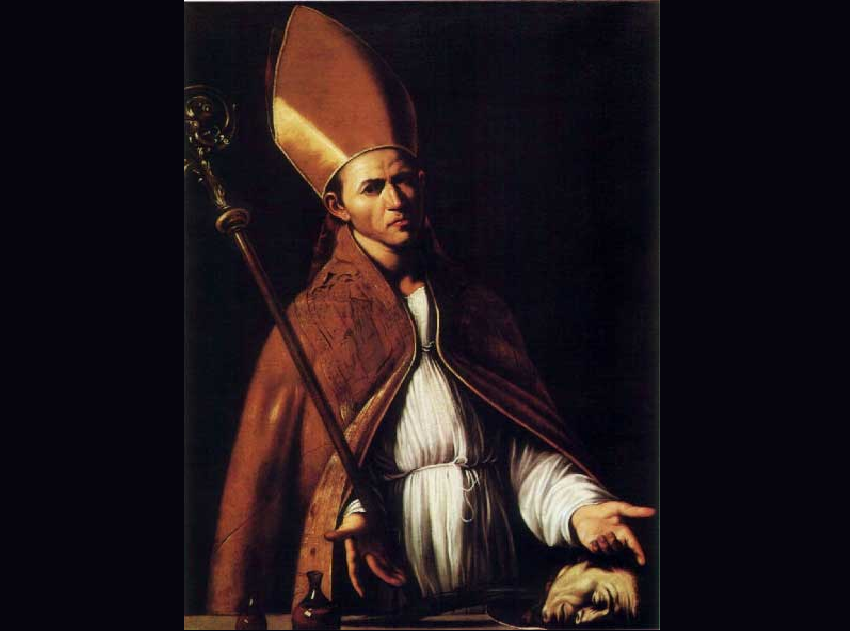
June 22
St. Paulinus of Nola
Life († 353)
Paulinus was of a family which boasted a long line of senators, prefects and consuls of Rome, and he was educated with great care. His genius and eloquence in oratory, prose and verse were the admiration of all the brilliant Christian minds of his time, including Saint Gregory the Great, Saint Ambrose, Saint Jerome, Saint Augustine, and Saint Martin of Tours. It is believed that Saint Ambrose would have chosen him to replace him as bishop of Milan, but Saint Paulinus was far from Milan when Saint Ambrose died. He said of him that Christians should follow and imitate Saint Paulinus, and that the greatest good fortune of the century in which they were living was to be witness to the life of so rare and admirable a man.
Saint Paulinus, at first Roman Consul and then Prefect or Governor of Rome, had more than doubled his wealth by his marriage with a virtuous Spanish noblewoman; he was one of the wealthiest and most honored men of his time, possessing domains in several nations of Europe. Though he was the chosen friend of Saints, he was still only a catechumen, and trying to serve two masters. But God drew him to Himself along the way of sorrows and trials. The first and only child of Paulinus and Theresia died shortly after birth. Saint Paulinus received baptism soon afterwards, at the age of thirty-eight, from the bishop of Bordeaux, Saint Delphin; then he withdrew into Spain to be at liberty to pray in solitude.
He was ordained a priest in Barcelona, and afterwards retired to Nola in Campania. And then, in consort with his holy wife, he liberated all his slaves, sold all his vast estates in various parts of the empire, distributing their proceeds so widely and generously that Saint Jerome says both East and West were filled with his alms. In Nola he built the magnificent Church of Saint Felix and served it night and day, living a life of extreme abstinence and toil. He and his wife agreed to live as brother and sister; they exchanged their silver utensils for those of wood and pottery, and wore robes of rude cloth, practicing from that time on a genuine poverty. Certain highly-placed worldly persons were very much offended by this abrupt change in the way of life of these persons of such great dignity.
Nonetheless, in 409 Saint Paulinus was chosen Bishop of Nola, and for more than thirty years so ruled as to be conspicuous, in an age blessed with many great and wise bishops. Saint Gregory the Great tells us that when the Vandals of Africa made a descent on Campania, Paulinus spent all he had in relieving the distress of his people and redeeming them from slavery. Finally, when all had been disposed of, there came to him a poor widow, whose only son had been taken away by the son-in-law of the Vandal king. What I have I give you, said the Saint to her; we will go to Africa and you will offer me to the prince, saying I am one of your slaves, in exchange for the prisoner. Her resistance once overcome, they went, and Paulinus was accepted in place of the widow's son and employed as gardener. After a time the king discovered, by divine interposition, that this valuable slave of his son-in-law was the renowned Bishop of Nola. He at once set him free, granting him also the freedom of all the townsmen of Nola who were in slavery.
One who knew Saint Paulinus well says he was meek as Moses, as priestly as Aaron, innocent as Samuel, tender as David, wise as Solomon, apostolic as Peter, loving as John, cautious as Thomas, brilliant as Stephen, fervent as Apollos. Saint Paulinus died in 431. His holy remains were transferred several times but restored to the cathedral of Nola in 1908.
Les Petits Bollandistes: Vies des Saints, by Msgr. Paul Guérin (Bloud et Barral: Paris, 1882), Vol. 7; Little Pictorial Lives of the Saints, a compilation based on Butler's Lives of the Saints, and other sources by John Gilmary Shea (Benziger Brothers: New York, 1894).
Scripture (2 Cor 8:9-15)
Musical Selection
Lord God,
you made the holy bishop Paulinus of Nola
renowned for his love of poverty and his pastoral concern;
grant in your goodness
that we who celebrate his virtues
may also imitate his love for others.
We ask this through our Lord Jesus Christ, your Son,
who lives and reigns with you in the unity of the Holy Spirit,
God for ever and ever. Amen. (ICEL; 1998)