May 28
Bl. Stefan Wyszynski
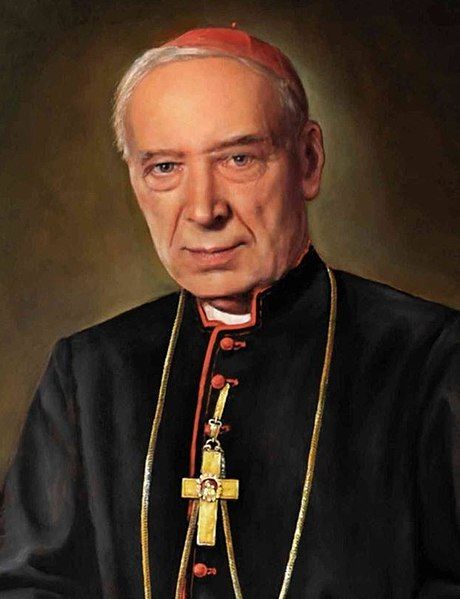
Life (1901-1981)
Stefan Wyszynski was born in a village called Zuzela on August 3, 1901, in what was then Russian territory due to the partitions of the late 18th century. At that time the Russian Empire had attempted to make the Polish people abandon their traditions and national awareness. His mother died when he was nine years of age. In 1912 his father sent him to Warsaw to complete his education. He enrolled in seminary and was ordained on his twenty-fourth birthday in 1924.
The next four years were spent in Lublin where he earned a doctoral degree in Canon Law and Social Sciences. Upon graduation he traveled extensively in Europe furthering his education. He then taught at the seminary in Wloclawek. His life changed dramatically with the onset of World War II in 1939 and with the Warsaw Uprising of 1944. At first he assumed pastoral duties for working class people, but eventually he became chaplain to members of the resistance movement. After the war, Wyszynski started a restoration project for the devastated seminary, became its rector and editor of a Catholic periodical.
On March 25th, 1946, Pope Pius XII appointed him Bishop of Lublin, and on November 12, 1948, Archbishop of Warsaw. His life was filled with political upheaval. Although the war had ended in 1944, a large segment of Poland was engaged in hostilities with the Stalinist government. The Catholic Church actively supported the anti-Communist government. In 1950 Wyszynski signed an agreement with the civil authorities that allowed the Church to hold property, separated church and state, prohibited religious teaching in public schools and allowed for civil authorities to select a bishop from three candidates. In 1953, more persecution swept Poland. When bishops supported the resistance, mass trials and imprisonment of priests began and Cardinal Wyszynski was among them. In 1953, he began his imprisonment in various locations enduring brutal torture and mistreatment, some highly perverse in nature. He was released in 1956.
Pope Pius XII elevated him to the rank of cardinal on January 12, 1953. He never stopped his religious and social work, the crowning achievement of which was the celebration of Poland’s Millennium of Christianity in 1966, the thousandth anniversary of the baptism of Poland’s first prince, Mieszko I. The Communist authorities refused to allow Pope Paul VI to visit Poland, and they prevented Cardinal Wyszynski from attending any celebrations outside of Poland connected to the millennium. In 1978, his brother bishop, Karol Wojtyla of Krakow became Pope John Paul II. Though sometimes at odds with each other, he will be known historically as the mentor of John Paul II. Cardinal Wysznski proposed Karol Wojtyla to be an auxiliary bishop in Poland.
Cardinal Wyszynski worked hard during the Solidarity movement in Poland, appealing to the government and the striking workers to be responsible for their actions. Cardinal Wyszynski, the Primate of the Millennium, died on May 28th, 1981. He was seventy-nine years of age. He was beatified on 12 September 2021 with Cardinal Marcello Semeraro presiding on Pope Francis’ behalf.
Source: https://www.papalartifacts.com/january-12-1953-the-rise-to-the-cardinalate-of-stefan-wyszynski-mentor-to-pope-john-paul-ii/
Scripture (Phil 1:12-13)
Writings
(Year A). Human work is love for God and for one’s brother. It is the reply of a rational being to the summons of love by which God asked us in a sublime manner to cooperate in His creative activity. Man plays the part of the second cause in the government, by Providence, of the world. From this derives the great dignity of man working with God and also the unusual dignity of his work: it is cooperation between man and God in both joys and sorrows. It is the work of prayer, worship, and the love of God. As such, work becomes for man the source of great new joy from the vocation and elevation by which he has been honored, from the knowledge that he is acting “hand in hand” with the Creator, from the graces of his state flowing over all his works, and from the actual grace given like a good spirit to all his efforts, labors, and works. A new joy flows from love for men. St. Paul bears witness to how necessary this love is in work: “I may give away all that I have, to feed the poor; I may give myself up to be burnt at the stake; but if I lack charity, it goes for nothing” (1 Cor. 13:3).
How many people burn themselves out at work! There is no lack either of people who, while proclaiming the dignity of work, look on it with hatred as a sad necessity. This is an almost universal tragedy, just as work is a universal phenomenon. And yet work has its usual reward in the love of men and the world. Through work a link is forged with other people, and this teaches us to love. Man works so as to create and renew the good things that are useful to his neighbors; the fruit of our work is the proof of our friendliness to other people. In this sense, work brings us closer to love of our neighbors in God. And therefore work cannot be carried out with a clenched fist and a shrivelled heart. The heart must unfold just as the hand must. Otherwise it is not real work. It is only at this price that the hardest work, like charity, “sustains, believes, hopes, and endures to the last” (1 Cor. 13:7). It is only then that the heaviest sacrifices that go with work can be faced without class hatred, only then that work gives out all those virtues without which it cannot be fruitful. “Charity is patient, is kind, feels no envy, is never perverse or proud, never insolent, does not claim its rights, cannot be provoked, does not brood over an injury; . . . but rejoices at the victory of truth” (1 Cor. 13:4-6). Of truth! Of this truth: that all creation is filled by the open hands of people, as by the open hands of God, with a plenitude of blessings.
And there is one more human joy in work, a joy that is really divine. This is the joy that comes from the fact that work done with love helps to achieve man’s redemption. When we unite our work with an act of love for God, by this love we lighten our labor; we wipe the sweat from our brows. When we undertake work from love of God, this merciful God lets us share in a task of great honor and efficacy — that of atonement. Thus it follows that work in the sweat of our brow both cleanses and ennobles us. The feeling of freedom that work gives is the highest joy. To gaze at God, face-to-face, gladdens us through all our toil and weariness. Our sorrow is turned into joy. (Sanctify Your Daily Life)
Musical Selection
Collect
O God, among the ranks of holy bishops
you have numbered blessed Stefan who was inflamed with love for you
and was filled with the faith that overcomes the world.
Through his intercession grant that we too may be steadfast in faith and love,
and one day take our place with him in glory.
We ask this through our Lord Jesus Christ, your Son,
who lives and reigns with you in the unity of the Holy Spirit,
God for ever and ever. Amen. (ICEL; 1998)