Introit
Collect
Grant, almighty God,
through the yearly observances of holy Lent,
that we may grow in understanding
of the riches hidden in Christ
and by worthy conduct pursue their effects.
Through our Lord Jesus Christ, your Son,
who lives and reigns with you in the unity of the Holy Spirit,
one God, for ever and ever. Amen. (RM)
First Reading Gn 2:7-9; 3:1-7
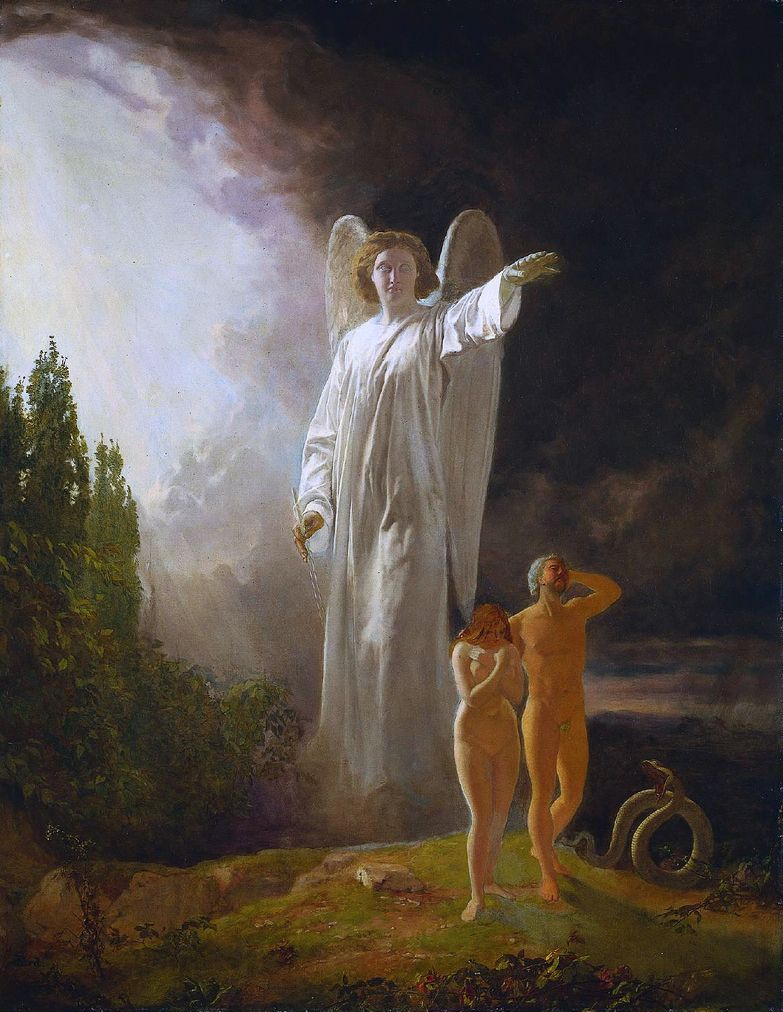
The Lord God formed man from the dust of the ground, and breathed into his nostrils the breath of life; and the man became a living being. 8 And the Lord God planted a garden in Eden, in the east; and there he put the man whom he had formed. 9 Out of the ground the Lord God made to grow every tree that is pleasant to the sight and good for food, the tree of life also in the midst of the garden, and the tree of the knowledge of good and evil. 16 And the Lord God commanded the man, “You may freely eat of every tree of the garden; 17 but of the tree of the knowledge of good and evil you shall not eat, for in the day that you eat of it you shall die.” 18 Then the Lord God said, “It is not good that the man should be alone; I will make him a helper as his patner.’ 25 And the man and his wife were both naked, and were not ashamed. 1 Now the serpent was more crafty than any other wild animal that the Lord God had made. He said to the woman, “Did God say, ‘You shall not eat from any tree in the garden’?” 2 The woman said to the serpent, “We may eat of the fruit of the trees in the garden; 3 but God said, ‘You shall not eat of the fruit of the tree that is in the middle of the garden, nor shall you touch it, or you shall die.’” 4 But the serpent said to the woman, “You will not die; 5 for God knows that when you eat of it your eyes will be opened, and you will be like God, knowing good and evil.” 6 So when the woman saw that the tree was good for food, and that it was a delight to the eyes, and that the tree was to be desired to make one wise, she took of its fruit and ate; and she also gave some to her husband, who was with her, and he ate. 7 Then the eyes of both were opened, and they knew that they were naked; and they sewed fig leaves together and made loincloths for themselves.
Responsorial Psalm Ps 51:3-4, 5-6, 12-13, 17
R/. Be merciful, O Lord, for we have sinned.
Second Reading Rom 5:12, 17-19
Just as sin came into the world through one man, and death came through sin, so death spread to all, because all have sinned. 13 Sin was indeed in the world before the law, but sin is not reckoned when there is no law. 14 Yet death exercised dominion from Adam to Moses, even over those whose sins were not like the transgression of Adam, who is a type of the one who was to come. 15 But the free gift is not like the trespass. For if the many died through the one man’s trespass, much more surely have the grace of God and the free gift in the grace of the one man, Jesus Christ, abounded for the many. 16 And the free gift is not like the effect of that one person’s sin. For the judgment following one trespass brought condemnation, but the free gift following many trespasses brings justification. 17 If, because of the trespass of one, death exercised dominion through that one, much more surely will those who receive the abundance of grace and the free gift of righteousness exercise dominion in life through the one, Jesus Christ. 18 Therefore just as the trespass of one led to condemnation for all, so the act of righteousness of one leads to justification and life for all. 19 For just as by the disobedience of one person the many were made sinners, so by the obedience of one person the many will be made righteous.
Gospel Acclamation
Gospel Mt 4:1-11
After being baptized, 1 Jesus was led up by the Spirit into the wilderness to be tempted by the devil. 2 He fasted forty days and forty nights, and afterwards he was famished. 3 The tempter came and said to him, “If you are the Son of God, command these stones to become loaves of bread.” But he answered, “It is written, ‘One does not live by bread alone, but by every word that comes from the mouth of God.’” 5 Then the devil took him to the holy city and placed him on the pinnacle of the temple, saying to him, 6 “If you are the Son of God, throw yourself down; for it is written, ‘He will command his angels concerning you,’ and ‘On their hands they will bear you up, so that you will not dash your foot against a stone.’” 7 Jesus said to him, “Again it is written, ‘Do not put the Lord your God to the test.’” 8 Again, the devil took him to a very high mountain and showed him all the kingdoms of the world and their splendour; 9 and he said to him, “All these I will give you, if you will fall down and worship me.” 10 Jesus said to him, “Away with you, Satan! for it is written, ‘Worship the Lord your God, and serve only him.’” 11 Then the devil left him, and suddenly angels came and waited on him.
Catena Nova
We must not expect baptism to release us from the temptations of our persecutor. The body that concealed him made even the Word of God a target for the enemy; his assumption of a visible form made even the invisible light an object of attack. Nevertheless, since we have at hand the means of overcoming our enemy, we must have no fear of the struggle. Flaunt in his face the water and the Spirit. In them will be extinguished all the flaming darts of the evil one….as he retreated before Christ, the light of the world, so will he depart from those illumined by that light. Such are the gifts conferred by baptism on those who understand its power; such the rich banquet it lays before those who hunger for the things of the Spirit. (St. Gregory Nazianzen)
Our greatest protection is self-knowledge, and to avoid the delusion that we are seeing ourselves when we are in reality looking at something else. This is what happens to those who do not scrutinize themselves. What they see is strength, beauty, reputation, political power, abundant wealth, pomp, self-importance, bodily stature, a certain grace of form or the like, and they think that this is what they are. Such persons make very poor guardians of themselves: because of their absorption in something else they overlook what is their own and leave it unguarded. How can a person protect what he does not know? The most secure protection for our treasure is to know ourselves: each one must know himself as he is, and distinguish himself from all that he is not, that he may not unconsciously be protecting something else instead of himself. (St. Gregory of Nyssa)
“I heard a voice speaking to me: ‘The young woman whom you see is Love. She has her tent in eternity… It was love which was the source of this creation in the beginning when God said: ‘Let it be!’ And it was. As though in the blinking of an eye, the whole creation was formed through love. The young woman is radiant in such a clear, lightning-like brilliance of countenance that you can’t fully look at her… She holds the sun and moon in her right hand and embraces them tenderly…The whole of creation calls this maiden ‘Lady.’ For it was from her that all of creation proceeded, since Love was the first. She made everything… Love was in eternity and brought forth, in the beginning of all holiness, all creatures without any admixture of evil. Adam and Eve as well were produced by love from the pure nature of the Earth.” (St. Hildegard of Bingen)
‘To relieve humanity of the death that our own disobedience had brought, I tenderly and providently gave you my only-begotten Son to heal you and bring satisfaction for your needs. I gave him the task of being supremely obedient, to free the human race of the poison that your first parent’s disobedience had spread throughout the world. Falling in love, as it were, with his task, and truly obedient, he hurried to a shameful death on the most holy Cross. By his most holy death he gave you life: not human life this time, but with the strength of his divinity. (St. Catherine of Siena)
In this desert of solitary prayer, Jesus is tempted. If we look more closely at these three temptations of our Lord, we see that in all three the devil seized on the apparent discrepancy between what Jesus knew about himself and what he was so immediately experiencing. Jesus knew that he was the Son of God. On this the devil - however we are to conceive him - fastened. If you are the Son of God, he says, then you should not be hungry, you should not be unheeeded, you should not be powerless…. And what does Jesus do? He once again abandons, so to speak, his awareness of his divinity and takes his place on the side of the poor, the abandoned, and the weak. (Karl Rahner)
The truthfulness which Jesus demands from His followers is the self-abnegation which does not hide sin. Nothing is then hidden, everything is brought forth to the light of day. In this question of truthfulness, what matters first and last is that a man's whole condition should be exposed, his whole evil laid bare in the sight of God. But sinful men do not like this sort of truthfulness, and they resist it with all their might. That is why they persecute it and crucify it. It is only because we follow Jesus that we can be genuinely truthful, for then He reveals to us our sin upon the cross. The cross is God's truth about us, and therefore it is the only power which can make us truthful. When we know the cross we are no longer afraid of the truth. (Dietrich Bonhoeffer)
Even in our penitential exercises, when we could least have hoped to find a pattern in Him, Christ has gone before us to sanctify them to us. He has blessed fasting as a means of grace, in that He has fasted; and fasting is only acceptable when it is done for His sake.... Well then, in the Services of this first Sunday, do we place the thought of Him before us, whose grace must be within us, lest in our chastisements we beat the air and humble ourselves in vain. (St. John Henry Newman)
Homily
[The following reflection by a Franciscan priest is recommended for further Lenten reflection]
Intercessions (Joe Milner; The Sunday Website)
For the Church: that the Spirit will deepen our identity as daughters and sons of God, inspire us on our Lenten journey, and help us to live as faithful disciples.
For the grace of conversion: that the Spirit will help us to recognize our dependence upon God and free us from our pride which seeks to convince us that we can save ourselves.
For all who struggle with attractions to wealth, power, and control: that God will free their hearts and guide them to a life of faith and trust.
For those who struggle with addiction: that the Spirit of God will help them recognize the harm that follows from addictive behavior and give them the strength to make life-giving choices.
For all who must fast every day, particularly the homeless, refugees, and those recovering from natural disasters: that our fasting may make us more aware of them and our hearts more generous towards them.
For deeper respect for the world which God created: that we may recognize the land, water, and air as God's gifts to all the human family and be good stewards of them.
For all victims of gun violence: that God will heal their physical and emotional wounds, give eternal rest to those who have died, and inspire us with new ways to end violence in our society.
For all who are homebound: that they may experience God’s presence in their prayer, in their family members, and in the visits from members of their faith community.
Lord our God, in every age you call a people to hear your word and to do your will. Renew us in these Lenten days: washed clean of sin, sealed with the Spirit, and sustained by your living bread, may we remain true to our calling and, with the elect, serve you alone. Grant this through Christ our Lord. Amen. (ICEL; 1998)
Offertory Chant
Offertory Hymn
Praise to the Holiest in the height, and in the depth be praise: in all his words most wonderful, most sure in all his ways.
O loving wisdom of our God!¨ When all was sin and shame, a second Adam to the fight and to the rescue came.
O wisest love! that flesh and blood, which did in Adam fail, should strive afresh against the foe, should strive and should prevail;
And that a higher gift than grace should flesh and blood refine, God's presence and his very self, and essence all-divine.
O generous love! that he, who smote in Man for man the foe, the double agony in Man for man should undergo;
And in the garden secretly, and on the cross on high, should teach his brethren, and inspire to suffer and to die.
Praise to the Holiest in the height, and in the depth be praise: in all his words most wonderful, most sure in all his ways.
Communion Antiphon
Closing Hymn
Forty days and forty nights, Thou wast fasting in the wild; ¨Forty days and forty nights, Tempted, and yet undefiled.
Sunbeams scorching all the day;¨ Chilly dew-drops nightly shed;¨ Prowling beasts about Thy way; ¨Stones Thy pillow; earth Thy bed.
And if Satan, vexing sore, flesh or spirit should assail, thou, his vanquisher before, grant we may not faint nor fail.
So shall we have peace divine:¨ Holier gladness ours shall be; ¨Round us, too, shall angels shine,¨ Such as ministered to Thee.
Keep, O keep us, Savior dear,¨ Ever constant by Thy side;¨ That with Thee we may appear, ¨At the eternal Eastertide.