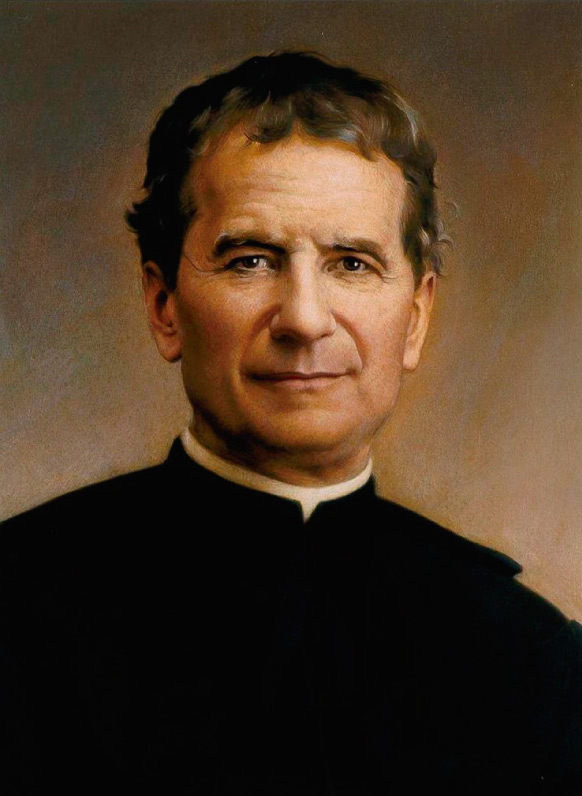
John Melchior Bosco was born in 1815 in Piedmont, northern Italy, the youngest son of a farmer. Losing his father when he was only two, John was brought up by his devout mother. Raising her family was a financial struggle, so the children knew the meaning of hardship. Giovanni’s career would prove him a man of great administrative skill, but his gifts were not only natural but supernatural. When he was only nine, for instance, he had the first of many vivid dreams that he firmly considered divine communications. In this first dream he saw himself in the midst of a crowd of fighting, cursing street-boys. He tried to calm them down, first by persuasion, then by flying fists. But a mysterious lady then appeared on the scene and said, “Softly, softly … if you wish to win them! Take your shepherd’s staff and lead them to pasture.” At that the boys in the dream turned into wild animals, then into lambs. Young John believed, from that moment on, that he was called to educate boys, not by harsh but by winning methods. At once the nine-year-old started with the poor boys of his own village, gathering them together, teaching them catechism and bringing them to church. To attract them he learned acrobatic and “magic” tricks, and became adept at these attention-getters.
Desiring to become a priest, Giovanni entered the seminary of Turin. While a seminarian, he got permission of his superiors to work on Sundays among the neglected apprentices and waifs of that large city. During these years he met the future St. Joseph Cafasso, who was then the rector of a Turinese church. Cafasso dissuaded him from aspiring to the foreign missions. His calling, said the saint, was to be a missionary among city boys. Actually, Don Bosco would in the end become a true missionary by spreading his educational work begun at Turin all around the world.
After ordination, Don Giovanni began experimenting with a catechetical and recreational center for apprentices and poor boys, and also started a night school. When this center became overcrowded, he established two additional “oratories”. He also took in a few dozen homeless children. Next he launched a school, with workshops to train shoemakers and tailors, to which he gradually added cultural courses. By 1856 he had 150 resident boys in the school, plus 500 in the oratories. The money to build shelters for all these activities came from Heaven-knows-where. Father Bosco had the marvelous gift of being able to control these lively pupils without any of the common methods of discipline, simply by positive means. Love, rather than formal punishment, was his secret. Meanwhile the young priest wrote many popular books, printed by the presses of his school.
Most of the work thus far was performed largely by Don Bosco himself, loyally aided by his mother. In 1859, to continue and expand his labors, he established a religious congregation called the Salesians, after St. Francis de Sales. By the death of the founder, the Salesians numbered 768, and they had already undertaken missionary work in other continents. Wherever they went, the Salesians, in addition to pastoral work, established schools at every level, trade schools in particular, printeries and bookbinderies, and hospitals. Don Bosco also established, in 1872, a religious order of sisters, the Daughters of Our Lady, Help of Christians.
Along the line, St. John Bosco had become noted as a preacher, and his reputation as a worker of miracles, especially healings, enhanced his influence both as an educator and a preacher. Because of his skill as a builder and financier of churches, Pope Pius IX entrusted him with the task of funding and building a church in honor of the Sacred Heart of Jesus in Rome. Thanks to his begging in France as well as Italy, Don Bosco succeeded in getting the church built; but he survived its dedication only nine months, dying on January 31, 1888. Forty thousand attended his wake in Turin, and all Turin, it seemed, took part in the funeral of this internationally important citizen. “In his life,” said Pope Pius XI, who canonized Don Bosco, “the supernatural almost became the natural and the extraordinary, ordinary.” --Father Robert F. McNamara
Scripture(Phil 4:4-9)
Rejoice in the Lord always. I shall say it again: rejoice! Your kindness should be known to all. The Lord is near. Have no anxiety at all, but in everything, by prayer and petition, with thanksgiving, make your requests known to God. Then the peace of God that surpasses all understanding will guard your hearts and minds in Christ Jesus. Finally, brothers and sisters, whatever is true, whatever is honorable, whatever is just, whatever is pure, whatever is lovely, whatever is gracious, if there is any excellence and if there is anything worthy of praise, think on these things.
Writings
(Year A). Look around you, my dear children, and see the wonders in the heavens and upon earth. The sun, moon, stars, air, water and fire are things that at one time did not exist. They could not have come into existence of themselves. God in his omnipotence made them out of nothing; hence he is called the “Creator”. When God, who always was and ever will be, had created what we see in this world of ours, he gave existence to man, who of all visible creation is the most perfect. Therefore our eyes, ears, tongue, hands, and feet are all gifts of God. Man is distinguished from all other animals in a special manner, for he is endowed with a soul that thinks and reasons, and desires what is good, and judges what is good or what is evil. The soul, since it is a spirit, cannot die with the body; for when the body has been carried to the grave, the soul enters on another life that will never cease. If during its time on earth it has done good, it will be ever happy with God in Paradise, where it will enjoy happiness for all eternity. But if it has done evil, it will be punished with terrible pain in hell, where it will undergo the torments of fire and loss forever. Bear in mind, my dear children, that we were created for Heaven. God, who is our loving Father, will condemn to Hell only those who deserve it on account of their sins. Oh! How much God loves us! How much God desires that we perform good works, so that we may share in that great joy which he has prepared for all of us in the eternity of Heaven. Since we are persuaded, my dear children, that we are created for Heaven, we should direct all our actions to this great end. The reward that God promises, and the punishment with which He threatens us should move us to act accordingly. Though He loves all people, since they are the work of His hands, still He has a particular love for the young, and tells us that He finds pleasure in their company: Deliciae meae esse cum filiis hominum. So then you are the delight and the love of the God who created you. God loves you, and He expects many good works of you; He loves you, because you are natural, humble and innocent; in a word, because you have not yet fallen a victim to the snares of the devil. Our Divine Saviour also shows a special kindliness towards you. He assures us that he considers all favours done to you as done to him. He threatens terribly those who give you scandal. Here are his own words: “But he that shall scandalise one of these little ones that believe in me, it were better for him that a mill-stone should be hanged about his neck, and that he should be drowned in the depth of the sea.” He wished children to follow him: he called them to himself, he embraced them and gave them his blessing. Since Our Lord loves you so much as the young people you are, you should form the sincere resolution to act in response to his love by doing whatever pleases him, and by avoiding whatever might offend him? Two places have been prepared for us in our future life. Hell for the wicked where they will suffer every pain. Heaven for the good where they will enjoy all sorts of good things. Our Lord also wants you to know that if you practise virtue in your youth, you will be confirmed in it for the remainder of your days, which will be followed by an eternity of glory. On the other hand, if you begin badly in your youth, you will surely continue so until death, and inevitably secure hell for yourself. Therefore, when you see people addicted to the vices of drunkenness, gambling or swearing, you can be sure that these vices began in their youth: Adolescens juxta viam suam, etiam cum senuerit non recedet ab ea (Pr 22:6). Ah! “Remember your Creator,” we are admonished, “in the days of your youth”; Indeed, elsewhere he declares that the man who began to observe the commandments from his youth is a happy man.” This truth was well known to the saints, especially to St Rose of Lima and St Aloysius Gonzaga, who very early on began to serve the Lord fervently, and later found no satisfaction save in what pertained to him, and thereby became great saints. The same can be said of the son of Tobias, who from the earliest days of his childhood was always obedient and submissive to his parents. When they died, he continued to live most virtuously until his death. But some of you may object: if we begin to serve God now, we shall become sad and depressed. This is not true. He who serves the devil is miserable, even if he pretends to be happy, because in his heart he never ceases to hear the reproach: You are unhappy because you are the enemy of God. Who was more affable or more cheerful than St Aloysius Gonzaga? Who was more happy and joyful than St Philip Neri? And yet we know that their lives were entirely spent in the practice of every virtue. Courage then, my dear friends; employ your time virtuously, and I assure you that your heart will always be happy and contented. As a consequence you will experience how sweet and pleasing it is to serve the Lord. (Companion of Youth for the Practice of Religious Duties)
Musical Selection
From nine years old he knew his mission, be humble persevere be strong. The lamb and wolf skin is your care now, God's love will carry you along.
Mary Help of Christians, Pray for us. Mary Help of Christians, Pray for us. Pray for us.
Don Bosco made no move without you, a loving mother, friend and guide. You lead him to your Son redeemer, His loving arms are open wide.
From that cold morning on your feast day, your holy mission he'd begun. With one Hail Mary and God's blessing, O Mother, look what you have done.
And now he's crying on the altar, these tears of joy he understands. The dream at age nine has come true now! His sons have spread throughout the land.
And now we pray to you, dear Mother, we are your children, make us one. "Da mihi animas" we live by, O Mary, lead us to your son.
Collect
All-powerful God, who called John Bosco to be a loving father and prudent guide of the young: give us his fervent zeal for souls and enable us to live for you alone; through Jesus Christ our Lord, who lives and reigns with you and the Holy Spirit, God, forever and ever. Amen.(English Missal)