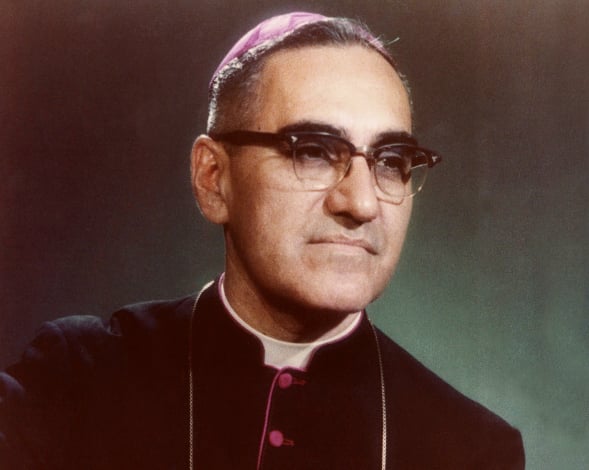
March 24
St. Oscar Romero
Life (1917-1980)
Óscar Arnulfo Romero y Galdámez was born in the small town of El Salvador known as Ciudad Barrios in 1917. His father trained him to be a carpenter, but from a very early age Óscar knew he wanted to be a priest. He left home at the age of 14, traveling by horse to the large city where he could study. He was ordained a priest for the Diocese of San Salvador in 1942 and quickly became a popular, well-known parish priest and editor of his diocesan newspaper. In 1967, he went to work for the bishops of El Salvador and soon became Bishop of Santiago de Maria. One day in 1975, soldiers raided a village in his diocese and killed many innocent people, claiming they were looking for hidden weapons. Bishop Romero was horrified. At the funerals of these villagers, he spoke about people’s human rights and how the military was wrong in the things they did. He even wrote to the country’s president. When he became Archbishop of San Salvador, the nation’s capital, the government began to turn on the Church, arresting priests and sending them to other countries, and killing people who protested against the leadership. The government killed a priest friend of the archbishop as a warning that he should keep quiet. Archbishop Romero excommunicated the murderers, announcing they could not receive Sacraments in the Church. The government closed Catholic schools, and more priests were tortured and killed, as were teachers of religion. Even possessing a Bible or a hymnbook became illegal. Protest for change must always take place within Gospel teaching, Archbishop Romero told the people of his country, asking them not to be violent. Soon, despite support from many other countries in the world, the archbishop became the target of the Salvadoran government’s anger. On March 24, 1980, he was gunned down by an unknown assassin while celebrating Mass in a small hospital chapel. The day before, he had asked Salvadoran soldiers to obey God and not the government. More than 250,000 Salvadorans attended his funeral, during which a bomb exploded and more people were killed. Many Salvadorans in the following years “disappeared,” never to be seen or heard from again—most likely killed. In 2010, the government of El Salvador formally apologized for the assassination of Archbishop Óscar Romero. In 1997, Pope John Paul II bestowed upon Óscar Romero the title of “Servant of God,” when his cause for canonization was opened. Archbishop Romero was a fearless defender of the poor and suffering in his nation, and he ultimately gave his life for them. In February of 2015, Pope Francis declared Archbishop Romero a martyr. The Church formally beatified him on May 23, 2015. On October 14, 2018, he was canonized, a saint of the Church.
Source: http://saintsresource.com/oscar-romero
Scripture (Rom 8:31b-‐39)
If God is for us, who is against us? He who did not withhold his own Son, but gave him up for all of us, will he not with him also give us everything else? Who will bring any charge against God’s elect? It is God who justifies. Who is to condemn? Is it Christ Jesus, who died, yes, who was raised, who is at the right hand of God, who indeed intercedes for us. Who will separate us from the love of Christ? Will hardship, or distress, or persecution, or famine, or nakedness, or peril, or sword? As it is written, ‘For your sake we are being killed all day long; we are accounted as sheep to be slaughtered.’ No, in all these things we are more than conquerors through him who loved us. For I am convinced that neither death, nor life, nor angels, nor rulers, nor things present, nor things to come, nor powers, nor height, nor depth, nor anything else in all creation, will be able to separate us from the love of God in Christ Jesus our Lord.
Writings
(Year A). Personal sin is at the base of the great social sin… How easy we find it to condemn structural injustice, institutional violence, and social sin! All that is quite real, but where are the sources of that social sin? They are in the heart of every person. Modern-day society is an anonymous society in which nobody accepts blame but everybody is responsible. All of us are responsible for what happens, but the sin remains anonymous. We are all sinners, and we have all contributed our grain of sand to this mountain of crimes and violence in our country. That is why salvation begins with the human person, with human dignity, with freeing every individual from sin. This is God’s call during Lent: let each and every one be converted! Among all of us who are here, there are not two sinners who are the same. Each of us has committed our own shameful deeds, but we want to hide them and shift the blame to others. I also am a sinner and must take off my mask. I have offended God and society, and I must ask forgiveness of God. This is the call of Christ: the human person comes first. The great task of Christians is to become absorbed in God’s kingdom and, with our souls so absorbed, to work also on the projects of history. It is a good thing to unite in the people’s organizations; it is a good thing to create political parties; it is a good thing to take part in government. All that is good, as long as you’re a Christian who reflects the kingdom of God and tries to implant it wherever you’re working—as long as you’re not a plaything of earthly ambitions. This is the great duty of today’s men and women. I have always told you, dear Christians, and I’ll tell you again: it is from here, from Christian groups, from the people of God that the true liberators of our people must emerge. Any historical project not founded on the themes we treated in our first point—the dignity of the human person, the will of God, the kingdom of Christ among us—will be an ephemeral affair. In contrast, the project that best reflects the eternal design of God will be ever more stable and ever more capable of working for the common good of all peoples according to their needs. I ask you, my dear brothers and sisters in politics, not to manipulate the church so that she will say what you want her to say. Rather, announce what the church is teaching, for she has no vested interests. I have no desire for power, and that is why I am completely free to tell power what is good and what is bad. I can tell any political group what is good and what is bad—that is my duty. As church, we need to unify our criteria on the basis of the freedom of God’s kingdom. For the church is not just the bishop and the priests; the church is all of you, the faithful, the religious, the Catholic schools, everything that is the people of God, the nucleus of all those who believe in Christ. We should not be disunited; we should not appear scattered. Often we may appear confused in dealing with the people’s political organizations, as if we were anxious to please them more than the kingdom of God and his eternal designs. We don’t have to beg anything from anybody because we have much to offer to everybody. This is not arrogance; it is the grateful humility of those who have received from God a revelation that is to be communicated to others. The liberation the church preaches is just as we have studied it today in the holy Bible. It is a liberation that respects above all the dignity of the person, the saving power of the common good of the people, and the transcendent vision that looks first of all toward God and derives its hope and its strength from God alone. (Lenten homily)
Musical Selection (Michael Joncas)
Collect
All powerful God,
who called Oscar Romero to give his life
for the poor and down-trodden in El Salvador:
grant that we may be united in serving your people
for the cause of justice and peace.
Grant this through Jesus Christ, your Son our Lord,
who lives and reigns with you,
in the unity of the Holy Spirit,
God, now and for ever. Amen. (English Missal)