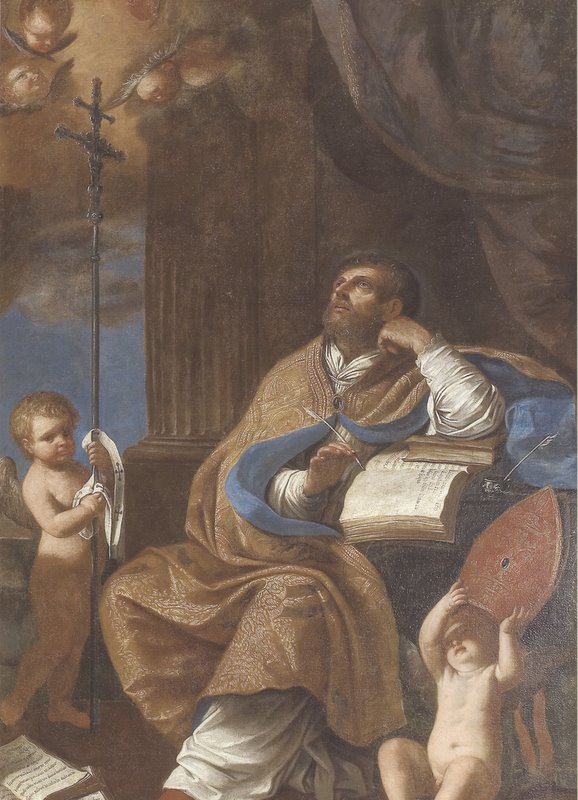
Few details of St. Peter Chrysologus' biography are known. He was born in the Italian town of Imola in either the late fourth or early fifth century, but sources differ as to whether this occurred around 380 or as late as 406. Following his study of theology, Peter was ordained to the diaconate by Imola's local bishop Cornelius, whom he greatly admired and regarded as his spiritual father. Cornelius not only ordained Peter, but taught him the value of humility and self-denial. The lessons of his mentor inspired Peter to live as a monk for many years, embracing a lifestyle of asceticism, simplicity, and prayer. His simple monastic life came to an end, however, after the death of Archbishop John of Ravenna in 430.
After John's death, the clergy and people of Ravenna chose a successor and asked Cornelius, still the Bishop of Imola, to journey to Rome and obtain papal approval for the candidate. Cornelius brought Peter, then still a deacon, along with him on the visit to Pope Sixtus III. Tradition relates that the Pope had experienced a vision from God on the night before the meeting, commanding him to overrule Ravenna's choice of a new archbishop. The Pope declared that Peter, instead, was to be ordained as John's successor.
In Ravenna, Peter was received warmly by the Western Roman Emperor Valentinian III, and his mother Galla Placidia. She is said to have given him the title of “Chrysologus” because of his preaching skills. Throughout the archdiocese, however, he encountered the surviving remnants of paganism along with various abuses and distortions of the Catholic faith. Peter exercised zeal and pastoral care in curbing abuses and evangelizing non-Christians during his leadership of the Church in Ravenna. One of the major heresies of his age, monophysitism, held that Christ did not possess a distinct human nature in union with his eternal divine nature. Peter laboured to prevent the westward spread of this error, promoted from Constantinople by the monk Eutyches.
The Archbishop of Ravenna also made improvements to the city's cathedral and built several new churches. Near the end of his life he addressed a significant letter to Eutyches, stressing the Pope's authority in the monophysite controversy. Having returned to Imola in anticipation of his death, St. Peter Chrysologus died in 450, one year before the Church's official condemnation of monophysitism. He is credited as the author of around 176 surviving homilies.
The saint's title, Chrysologus, signifies “golden speech” in Greek. Named as a Doctor of the Church in 1729, he is distinguished as the “Doctor of Homilies” for the concise but theologically rich reflections he delivered during his time as the Bishop of Ravenna. His surviving works offer eloquent testimony to the Church's traditional beliefs about Mary's perpetual virginity, the penitential value of Lent, Christ's Eucharistic presence, and the primacy of St. Peter and his successors in the Church.
To me, the very least of all the holy ones, this grace was given, to preach to the Gentiles the inscrutable riches of Christ, and to bring to light for all what is the plan of the mystery hidden from ages past in God who created all things, so that the manifold wisdom of God might now be made known through the Church to the principalities and authorities in the heavens. This was according to the eternal purpose that he accomplished in Christ Jesus our Lord, in whom we have boldness of speech and confidence of access through faith in him.
Writings
(Year A).We have heard from the blessed Apostle that there were two founders of the human race, Adam and Christ; two men alike in body but unlike in dignity; completely similar in physical makeup but totally dissimilar in origin. He says that the first man, Adam, became a living soul; the last Adam became a life-giving spirit. The first was made by the second from whom he also received the breath of life; the second was his own creator and fashioner, for he did not look for life from another, but was himself the sole source of life for everyone. The first was moulded from the common earth; the second came forth from the blessed womb of the Virgin. In the first earth became human; in the second human nature was raised to divinity. What more can I say? It was the second Adam who stamped his own image upon the first when he created him. That is why he assumed the role of the first Adam, so that what he had fashioned in his own image should not perish.
There was then a first Adam and a last Adam. The first had a beginning, the last is unbounded, for the last Adam is in fact the first, as he himself says: I am the first and the last. I am the first, because I have no beginning; I am the last, because I have no end. But it is not the spiritual that comes first, says the Apostle, but the physical, and then the spiritual. The earth exists before the fruit, though it is of less value than the fruit. The earth exacts toil and sighs, whereas the fruit provides nourishment and vitality. Rightly does the Prophet glory in such fruit when he says: Our earth has brought forth its fruit. What sort of fruit? Clearly, that of which he says elsewhere: A son, the fruit of your body, I will place upon my throne.
The first man, says the Apostle, being made of the earth is earthly; the second who comes from heaven is heavenly. The earthly man is the pattern for earthly people; the heavenly man for heavenly people. But how is it possible to receive a nature with which one is not born? How if not by ceasing to be what we were and persevering in what we have become through rebirth? For this, my friends, the heavenly Spirit fructifies the virginal womb of the font with the invisible communication of his radiance, so that it may bring forth as heavenly offspring, and transform into the likeness of their Creator, those who had sunk into a miserable earthly condition because they were fashioned from slime.
Therefore, now that we have been reborn and refashioned in the image of our Creator, let us do as the Apostle says: As we have borne the image of the earthly man, so let us also bear the image of the heavenly man. Let us be completely like our Creator, not in the majesty which belongs to him alone, but in the innocence, simplicity, gentleness, patience, humility, and friendliness which he has deigned to share with us.(Sermon 117)
Musical Selection
Your words are spirit and life, O Lord
Richer than gold, stronger than death
Your words are spirit and life, O Lord
Life everlasting
God's law is perfect, refreshing the soul
Reviving the weary spirit
God's rule can be trusted: bringing us wisdom
Bringing God's wisdom to birth
Your words are spirit and life, O Lord
Richer than gold, stronger than death
Your words are spirit and life, O Lord
Life everlasting
Living by God's truth is holy and sure
God's presence is everlasting
God's truth is eternal, bringing us justice
Bringing God's justice to earth
Your words are spirit and life, O Lord
Richer than gold, stronger than death
Your words are spirit and life, O Lord
Life everlasting
God's word is precious, desired more than gold
Worth more than we dare imagine
And, sweeter than honey, this word will feed us
Bringing fulfillment and joy
Your words are spirit and life, O Lord
Richer than gold, stronger than death
Your words are spirit and life, O Lord
Life everlasting
Collect
Almighty Father, who put golden words in the mouth of the bishop Peter that he might teach and protect the faith entrusted to him: grant to all who reach in your name the grace of careful preparation, human warmth and the divine fervour of your holy ones. We ask this in the name of Jesus Christ your Son our Lord, who lives and reigns with you, in the unity of the Holy Spirit, God, now and for ever. Amen.(English Missal)