October 10
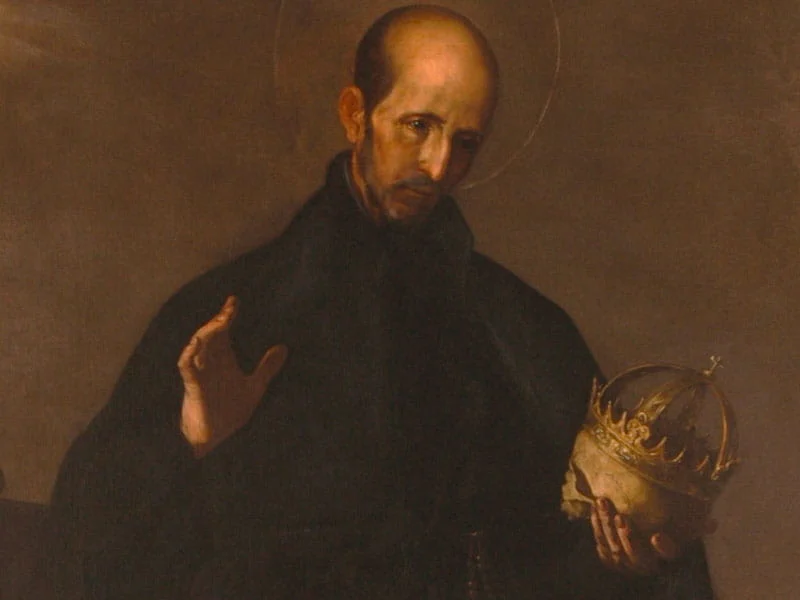
St. Francis Borgia
Life (1510-1572)
The name “Borgia” doesn’t suggest “saint”. Sensational gossip has represented the Borgias, a noble Spanish/Italian family of the Renaissance, as monsters, but the unvarnished facts about them are bad enough. Key figure of this ambitious clan was Rodrigo Borgia, who became Pope Alexander VI. Rodrigo was an able ruler, but, as it is well known, he ignored his priestly celibacy and fathered several children. Rodrigo secured for his son, John, the dukedom of Gandia in Spain. Francis Borgia, John’s grandson, was born in 1510.
Francis belonged to the high ruling class of Spain. Created Marquis of Lombay in 1528, he married a noble woman, Eleanor de Castro. His cousin, Emperor Charles V named him viceroy of Catalonia. This job gave him excellent training in administration. At the same time, he was a devout Catholic. People at court even criticized him for receiving Communion too often! When he became duke of Gandia on the death of his father, he retired from public affairs so that he might spend more time with his wife and eight children.
Eleanor died in 1546. This was a turning point in Francis’ life. He had become an acquaintance and admirer of St. Ignatius Loyola, founder of the new religious order, the Jesuits. Now he asked that he be admitted into that community as soon as family details could be worked out. Meanwhile, he quietly studied theology for the priesthood. By 1550, his children were provided for, so he entered the Society of Jesus. Naturally, the aristocratic world was startled to hear of a “duke turned Jesuit.” Francis himself sought to become as humble as possible, but it was hard to break his old acquaintances from, for example, bowing to him.
In 1554, St. Ignatius named Francis commissary general of the Jesuits of Spain and Portugal. This meant he was practically the head of the order in those countries. His skill as an administrator and his close friendships with the Spanish aristocrats were of great assistance to him in his work. In 1565 this widower-priest was elected father-general of the whole Jesuit order. The seven years of his generalship saw a great expansion of the Society. He multiplied its schools in Europe and its missions in the Far East and in America. (In 1566, for instance, he sent the first Jesuit mission to Florida.)
But Francis did not merit his halo just because he was a good executive. He was also a thoroughly good man, with a great zeal for personal perfection, for works of mercy, and for the reconstruction of a Church that had been badly shaken by the Protestant Reformation. Thus, St. Francis Borgia has been well described as “one of the sweetest, dearest, noblest men our poor old world has known.”
Now, I can’t find any specific proof for it, but I suspect that one reason why St. Francis decided to give his life to God was to make up to Him for the ungodliness of some of his ancestors. Others have undertaken voluntary reparation of this sort, and God must be pleased with their generosity. Of course, even when we volunteer to become “saints for sinners”, we must acknowledge, as Francis Borgia did, that we, the “saints,” are sinners too. — Father Robert F. McNamara
Scripture: Sirach 45:1-6
From his descendants the Lord brought forth a man of mercy,
who found favor in the sight of all flesh
and was beloved by God and man,
Moses, whose memory is blessed.
He made him equal in glory to the holy ones,
and made him great in the fears of his enemies.
By his words he caused signs to cease;
the Lord glorified him in the presence of kings.
He gave him commands for his people,
and showed him part of his glory.
He sanctified him through faithfulness and meekness;
he chose him out of all mankind.
He made him hear his voice,
and led him into the thick darkness,
and gave him the commandments face to face,
the law of life and knowledge,
to teach Jacob the covenant,
and Israel his judgments.
He exalted Aaron, the brother of Moses,
a holy man like him, of the tribe of Levi.
Writings
Musical Selection
Collect