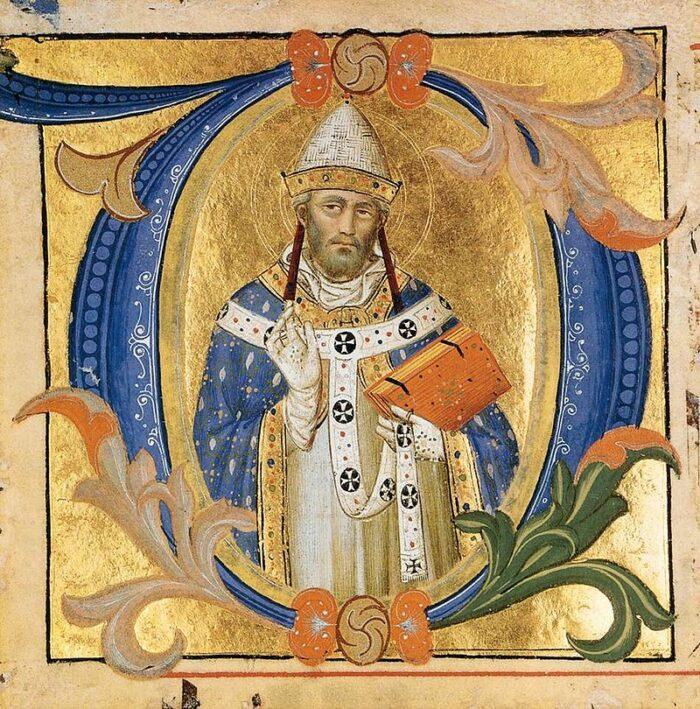
(First century)
The earliest lists of the men who succeeded St. Peter as bishops of Rome tell us that the first was named Linus; the second, Cletus; and the third, Clement. Little is known for sure about Clement’s life and death. Was the Clement that St. Paul refers to as assisting him the future pope? Not likely. But St. Irenaeus (2nd century) says that St. Clement was a friend of both SS. Peter and Paul.
If we do not know his dates, we know something of the man himself from the letter he wrote to the Christians of Corinth, Greece, in the period 95-100 A.D. It is not a long letter, but it gives precious information about how Christians thought and acted in the later apostolic age. (When Clement reigned as pope, St. John the Evangelist was probably still alive.) For one thing, St. Clement gives us valuable information about the presence and death in Rome of Saints Peter and Paul. He calls these apostles “the greatest and most holy pillars” of the Church, who were “persecuted and fought to the death.” In the same period, he says, many other Christians, a “multitude of the elect”, men and women alike, were tortured and executed out of “jealousy”. This was the Roman phase of the first Roman persecution, begun by Emperor Nero in A.D. 65-67.
The New Testament does not specify how Jesus commanded the apostles to continue a hierarchy in the church, but St. Clement describes the apostolic practice. Our Lord, he says, sent the apostles out to preach to the whole world with authority to name some of their disciples to rule the churches that they founded. Then, following Christ’s instructions, “they laid down a rule once for all to this effect: when these men die, other approved men shall succeed to their sacred ministry.” Therefore, it is wrong, he concludes, for a given church to oust from office any man properly chosen for that office. (Here we have an indication of the origin and importance of “apostolic succession” that gives the Church the note of “apostolic”).
Clement also teaches, implicitly yet clearly, the doctrine of the popes’ primacy over the whole Church. The purpose of his letter was to warn the Corinthian Christians to settle their intramural bickerings. If the Corinthians had thought Clement was thus intruding into their local church affairs, they would surely have protested. Actually they held his letter in almost as great reverence as they did the two letters written to them by St. Paul.
I find it thrilling to read the writings of Clement and the other early Church Fathers. They use the same scriptures we use. They teach the same doctrines that we believe. Thus at one point, St. Clement speaks of the doctrine of love that Jesus taught and the New Testament authors passed on. “Love unites us to God,” says St. Peter’s friend and third successor. “Love covers a multitude of sins (I Peter, 4:8). Love endures all things, is longsuffering in everything. There is nothing vulgar in love, nothing haughty. Love makes no schism; love does not quarrel; love does everything in unity (I Cor. 13,4-7). In love we’re all the elect of God perfected; without love nothing is pleasing to God. In love did the Master take hold of us. For the sake of the love which He had for us did Jesus Christ our Lord, by the will of God, give His blood for us, His flesh for our flesh, and His life for our lives.”
This was the faith of Pope St. Clement I. This is our faith. The centuries change it not. --Father Robert F. McNamara
Scripture (1 Pet 5:1-4)
It is right and holy, therefore, brethren, that we should be submissive to God rather than follow those who through arrogance and insubordination are the ringleaders in a quarrel fomented by detestable jealousy. No ordinary harm, surely, but serious danger shall we incur if we recklessly yield to the caprices of men who plunge into strife and sedition to estrange us from the cause of right. Let us be kind to one another in imitation of the compassion and goodness of our Maker. For the Scripture says: The kind shall inhabit the land, and the innocent shall be left in possession of it; but the transgressors shall be exterminated. And again it says: I saw a godless man rear his head to unseemly heights like the cedars of Lebanon; and I passed by, and behold, he was no more! And I searched for his place, and I did not find it. Cherish guilelessness and aim at sincerity, for posterity belongs to the peaceable man.
Therefore let us associate with those who piously cultivate peace, and not with those whose peaceful intentions are but a mask. For somewhere it is said: This people honors me with its lips; but its heart is far away from me. And again: With their lips they blessed, but with their hearts they cursed. And again it is said: They loved Him with their lips, and with their tongue they lied to Him; but their heart was not sincere with Him, nor did they prove faithful to His covenant. Therefore struck dumb shall be the treacherous lips that speak evil against the good man. And again: May the Lord destroy all the deceitful lips, the boastful tongue, the men that say: “Great glory will we win by our tongue, our lips are our own: who is lord over us?” Because of the wretchedness of the needy and the sighs of the poor, I will now rise, says the Lord; I will bring relief, and boldly will I act in bringing it.
For it is to the humble-minded that Christ belongs, not to those who exalt themselves above His flock. The Scepter of the Divine Majesty, the Lord Jesus Christ, did not, for all His power, come clothed in boastful pomp and overweening pride, but in a humble frame of mind, as the Holy Spirit has told concerning Him; for He says: Lord, who has believed our teaching? And the arm of the Lord–to whom has it been revealed? Looking at Him, we announced, as it were, a child, a root, as it were, in thirsty ground; there is no shape, no comeliness in Him; yes, we saw Him, and neither shape nor beauty did He have; but His shape was dishonorable and shrunken beside the shape of men; a man covered with wounds and the marks of hardship; one acquainted with infirmity; because His face is turned away, He has been dishonored and held in disrespect. Our sins it is that this Man bears, and for our sake He is in pain; and we regarded Him as one afflicted and bruised and ill-treated. But He was wounded for our sins, and languishes because of our iniquities; to give us peace He is under chastisement; by His bruises we were healed. We all, like sheep, had gone astray; each man had wandered from his path. And the Lord delivered Him up for our sins; yet He does not, because He is abused, open His mouth. As a sheep He was led to the slaughter, and as a lamb dumb before the shearer He does not open His mouth. Because of His abasement His condemnation was taken away. As to His generation–who can fathom their minds? From the land of the living is He removed! Because of the iniquities of my people is He come to death! But I will deliver up the wicked for putting Him in the grave, and the rich for putting Him to death; for evil He has not done, nor was guile found on His lips. And the Lord is pleased to free Him from His evil plight. If you make an offering for sin, you will see a long-lived posterity. I And the Lord is pleased to take away the torment of His soul, to show Him light, and mold Him through understanding, and thus to render justice to a just man who served many well; and He will take upon Himself the burden of their sins. For this reason He shall count a numerous inheritance and divide the spoils taken from the strong, because He was delivered up to death and classed among the lawless. And He took upon Himself the sins of many, and to atone for their sins He was delivered up. And again He says Himself: I am a worm and not a man, a disgrace among men and the contempt of the people. All that saw me mocked at me; they hissed at me, they shook their heads: “He trusted in the Lord: let the Lord deliver Him, let Him save Him, for He likes Him.” YOU see, beloved, what the example is that has been given us; for, if the Lord was so humble-minded, what ought we to do who have come under the influence of His grace through Him? (First Epistle to the Corinthians)
whose martyr Clement bore witness with his blood
to the love he proclaimed and the gospel that he preached:
give us thankful hearts as we celebrate your faithfulness
revealed to us in the lives of your saints
and strengthen us in our pilgrimage
as we follow your Son, Jesus Christ our Lord,
who is lives and reigns with you,
in the unity of the Holy Spirit,
God, forever and ever. Amen. (English Missal)