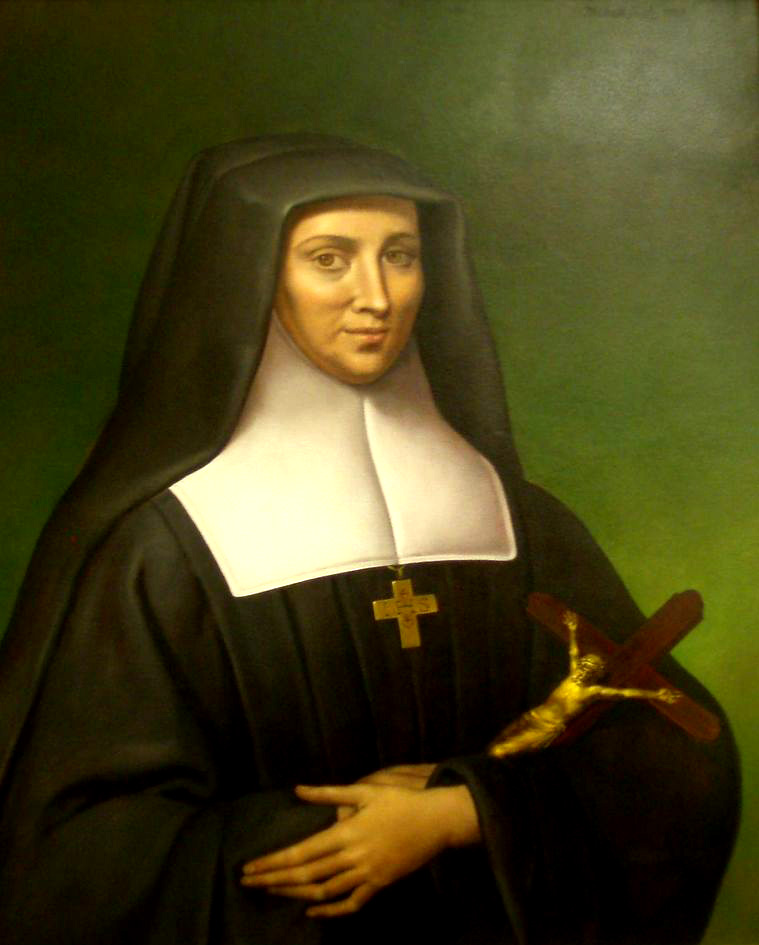
Once, along the line, Jane had a vision in prayer of a rather portly, bald and bearded man whom she had never seen before, with the intimation that this was her future spiritual director. While visiting her father in 1604, Jane and he went to hear a bishop who was becoming a famous preacher. It was St. Francis de Sales. Francis matched perfectly, even in clothing, the man of her vision. He accepted to become her spiritual guide. For that he was ideal, since he knew how to temper austerity with freedom. One day, for instance, when Jane appeared in a more attractive dress than usual, Francis asked, “Madam, do you wish to marry again?” “No indeed,” she replied. “Very well,” he said with a smile. “But then you should pull down your flag.” She took the hint. He always had just the right approach. Jane had thought of entering the convent. Francis deterred her until 1607. Then he told her he wanted her to help him found a convent of the “Visitation of the Virgin Mary”. It would be open especially to women disqualified by age or health from entering the older orders. It would not be cloistered, so that the members could go about on charitable errands. Jane was willing to cooperate, but what about her children? Well, the oldest girl married, and she left the boy at her father’s house. She took the two other girls into the convent. One died before long, the other married. The boy had been most upset at the separation. When she was about to leave home, the fifteen-year-old threw himself across the threshold. But she chose the harder way and stepped over him. Actually, mother and son loved each other dearly, and she deeply mourned his death in battle several years later. As foundress she had many trials. The local bishop insisted that her convent be cloistered; but she still opened it to widows, the elderly, and women in poor health. The plague caused her community grief, and there were many daily problems. But she accepted all with serenity, praying to God, “Destroy, cut, burn, whatever opposes Thy holy will.”
By 1641 there were 65 Visitandine convents in France. When she died, her body was buried at Annecy near that of St. Francis de Sales, with whom she had shared a unique friendship. She was canonized a saint in 1767. Of this remarkable widow, her friend St. Vincent de Paul said, “I regard her as one of the holiest souls I have ever met on this earth.” -- Father Robert F. McNamara
Writings
(Year A). I write because I cannot refrain from doing so; for this morning I am more wearisome to myself than usual. My interior state is so gravely defective that, in anguish of spirit, I see myself giving way on every side. Assuredly, my good Father, I am almost overwhelmed by this abyss of misery. The presence of God, which was formerly such a delight to me, now makes me tremble all over and shudder with fear. I bethink myself that the divine eye of Him whom I adore, with entire submission, pierces right through my soul looking with indignation upon all my thoughts, words and works. Death itself, it seems to me, would be less painful to bear than the distress of mind which this occasions, and I feel as if all things had power to harm me. I am afraid of everything; I live in dread, not because of harm to myself, but because I fear to displease God. Oh, how far away His help seems! thinking of this I spent last night in great bitterness and could utter no other words than these, “My God, my God, alas! why hast Thou forsaken me.” At daybreak God gave me a little light in the highest part of my soul, yet only there; but it was almost imperceptible; nor did the rest of my soul and its faculties share the enjoyment, which lasted only about the time of half a Hail Mary, then, trouble rushed back upon me with a mighty force, and all was darkness. Notwithstanding the weariness of this dereliction, I said, though in utter dryness, “Do, Lord, whatever is pleasing to Thee, I wish it. Annihilate me, I am content. Overwhelm me, I most sincerely desire it. Tear out, cut, burn, do just as Thou pleasest, I am Thine.” God has shown me that He does not make much account of faith that comes of sentiment and emotions. This is why, though against my inclination, I never wish for [felt] devotion. I do not desire it. God is enough for me. Notwithstanding my absolute misery I hope in Him, and I trust He will continue to support me so that His will may be accomplished in me. Take my feeble heart into your hands, my true Father and Lord, and do what you see to be wisest with it. (Letter to St. Francis de Sales)
Musical Selection (Kathleen Deignan)