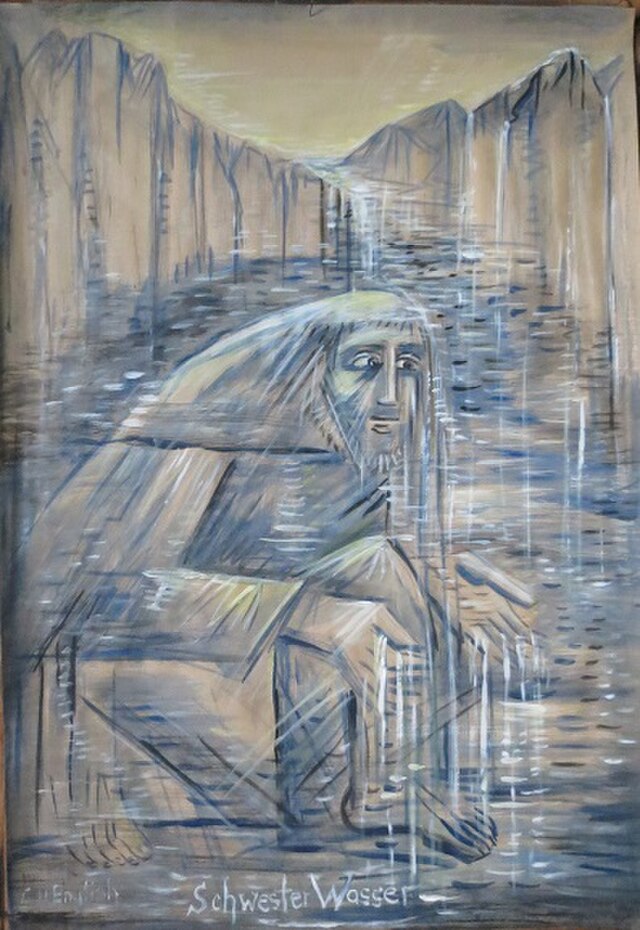
Sept 6
Scripture: Joshua 3:1, 13-17
14 So when the people broke camp to cross the Jordan, the priests carrying the ark of the covenant went ahead of them. 15 Now the Jordan is at flood stage all during harvest. Yet as soon as the priests who carried the ark reached the Jordan and their feet touched the water’s edge, 16 the water from upstream stopped flowing. It piled up in a heap a great distance away, at a town called Adam in the vicinity of Zarethan, while the water flowing down to the Sea of the Arabah (that is, the Dead Sea) was completely cut off. So the people crossed over opposite Jericho. 17 The priests who carried the ark of the covenant of the Lord stopped in the middle of the Jordan and stood on dry ground, while all Israel passed by until the whole nation had completed the crossing on dry ground.
Meditation
From her article Eco-Christology: Living Creation as the Body of Christ by Sr. Ilia Delio O.S.F.
https://relforcon.org/files/delio.eco-christology.creation_as_the_body_of_christ_0.pdf
A FRANCISCAN VIEW OF CREATION
The role of religion in relation to ecology may not seem like an obvious one but religion, like ecology, is about relatedness. The word “religion” comes from the Latin ligare which means to connect; it is also the root of the word “ligament.” To whom or to what are we connected? Although this question calls for a more comprehensive explanation than what can be provided here, still it is worthwhile recalling the function of religion, particularly Christianity, up to the late Middle Ages, before the rise of modern science. Essentially religion served to integrate and connect the human person to God, neighbor and creation. Although Neoplatonism shaped Christianity into a world-transcending religion, the central doctrine of incarnation—Word made flesh—kept it grounded in creation. Whereas some spiritual writers like Benedict and Augustine emphasized the risen Christ, others like Francis of Assisi and Ignatius of Loyola stressed the humanity of Christ, disclosing the immanence of God and the sacredness of creation.
Francis had a powerful experience of God while praying before an icon of the crucified Christ. This experience opened him up to the reality of God’s presence in the human person and in nature. Once revolted by the sight of lepers, Francis came to experience the sweetness of God in the kiss of the leper. Revelation was not an abstract idea for him but the movement of God to the poverty and humility of creaturely life. Growing in love with a God of outpouring love, Francis was led into solidarity with all creation as brother. Through his love of Christ crucified he came to see that nothing exists autonomously and independently; rather all things are related to each other because everything is created through the divine Word. All creation spoke to Francis of God and thus creation became the place for him to encounter God. To use a modern analogy, creation was God’s “facebook.” In beautiful things, Bonaventure wrote, Francis saw divine Beauty itself and from each and every thing he climbed up to embrace his Beloved.
Musical Selection (lyrics in video)
Prayer