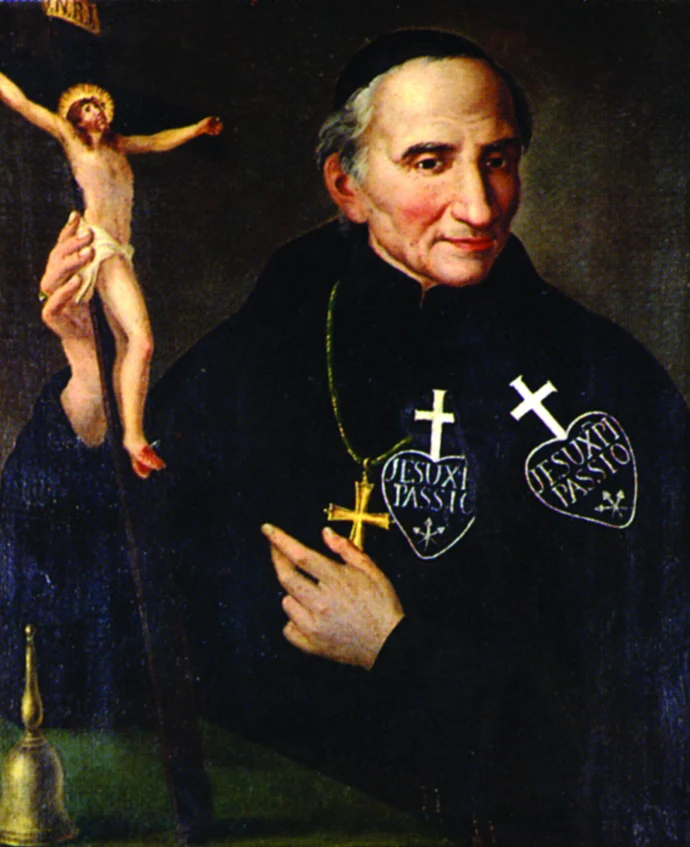
Being a good bishop of a diocese is no easy task. If many canonized saints are bishops, it must be because God, in His providence, has wanted to set before bishops plenty of examples of how best to discharge their duties as shepherds. St. Vincent Strambi was one such example.
Vincent was born near Rome, Italy, on New Year’s Day, 1745. As a boy he was full of life and fun, but he had an innate generosity that prompted him to give his coat or shoes to a poor child who needed clothing. Sensitive to their son’s goodness of heart, his parents were willing to cooperate when he showed a leaning towards the diocesan priesthood. Educated at the seminary of Bagnoregio, he was ordained a priest in 1767. By that time, however, he had fallen under the influence of St. Paul of the Cross, the founder of the Congregation of the Passion; and after only a year in the service of his diocese, he entered the Passionist order. To this his parents strongly objected.
But Vincent (or to give his name in religion, Stanislaus of the Sorrowful Mother), quickly became a leading figure in the Passionist community. First, he was sent out to preach parish missions, and this he did with remarkable success. Then he was appointed professor of theology and preaching in the Passionist seminary. Finally, he was entrusted with various administrative tasks, culminating in his election in 1781 as father provincial of the area’s Passionist province.
Italy soon became engulfed in the French Revolution, and fell into disarray. In 1801 Pope Pius VII named Father Strambi bishop of the combined sees of Macerata-Tolentino. Strambi’s humility made him try to decline the task, but his holiness proved him a worthy choice. There was no pomp in his episcopal palace. As bishop, Vincent continued to follow the rule of poverty and penitence characteristic of the Passionist order. The former seminary professor was especially happy to govern his diocesan seminary, taking personal interest in each of his future priests. He also organized clergy and laity into a team of religious instructors, and thus became a pioneer in the work of today’s Confraternity of Christian Doctrine. He proved to an able administrator of the goods of his diocese, and worked effectively for its spiritual revival. And, of course, he showed his usual solicitude for the aged, the ailing and the orphan.
In 1808, Napoleon was preparing to take over from the pope the States of the Church. He demanded of the bishops within the papal states an oath of allegiance to himself. Pius VII had already forbidden such an oath, so Strambi refused. Consequently he was sent into exile and eventually imprisoned, first at Novara, then at Milan. Only in 1814 was he able to return home, a year after Napoleon’s fall from power. The reception he received in Macerata bore witness to how his people loved their bishop. But his political troubles were not yet over. When Napoleon escaped from Elba in 1815 and tried to rally his generals, King Joachim Murat made Macerata his headquarters. When Murat was defeated by the Austrians at Tolentino, his troops then threatened to sack Macerata, but Bishop Strambi personally talked the commander into sparing it. Famine and an epidemic of typhus followed the military campaign. Once more the bishop’s leadership promoted a solution of these health problems.
In 1823 the new pope, Leo XII, allowed the Bishop of Macerata to resign his diocese. However, he brought him to Rome to be his confidential adviser. In this task Vincent’s devotion to the Church was once more exemplified. When Leo XII was stricken with what seemed to be a mortal illness, Strambi offered to God his own life in exchange for the recovery of the Holy Father. Leo did recover, but Bishop Vincent died shortly afterwards, on January 1, 1824, his 79th birthday. He had given his all for the Church.
St. Vincent was canonized in 1950. — Father Robert F. McNamara
Scripture: 2 Cor 4:1-2, 5-7
Since through God’s mercy we have this ministry, we do not lose heart.2 Rather, we have renounced secret and shameful ways; we do not use deception, nor do we distort the word of God. On the contrary, by setting forth the truth plainly we commend ourselves to everyone’s conscience in the sight of God. 5 For what we preach is not ourselves, but Jesus Christ as Lord, and ourselves as your servants for Jesus’ sake.6 For God, who said, “Let light shine out of darkness,”made his light shine in our hearts to give us the light of the knowledge of God’s glory displayed in the face of Christ.7 But we have this treasure in jars of clay to show that this all-surpassing power is from God and not from us.
Writings
(Year A).The book of life, written inside and out Oh, the great book which is the holy Crucified! A book full of the secrets of the sublime knowledge and loving wisdom of God. A book indeed of life, because it teaches the way which leads certainly to life and communicates life, vigor and the power to become a saint through the graces which flow from it.
This book is written inside and outside. The book written inside: Come, lovers of Jesus: with deep reverence and humble confidence enter into the sanctuary of his heart. There contemplate that most profound humility by which, burdened with all our sins, he takes upon himself all the ignominies and sorrows which he suffers. At such a sight, who of us will still dare to be proud?
Contemplate also that very great and unconquerable patience by which he complains neither about wicked judges, a foolish people nor cruel executioners. He does not complain about friends who abandon him, nor about his own heavenly Father who wills that he be wounded, tortured and reduced to the extremes of humiliation. At such a sight, who of us will want to complain about his own small trials, due unfortunately to our own sins?
Finally, contemplate the immense and heartfelt charity by which he suffers for all, and in suffering for all, has each one in particular in sight as if he suffers for that one alone: He loved me and gave himself for me. Who would not want to return that love to a God who has anticipated us in love, and with such an excess of
love?
Come, O Christians, and consider the lessons which appear in this divine book also written on the outside. Look at it.
What humiliation for Jesus! To die condemned' as a criminal, to die on the most infamous gibbet, to die between two robbers, as though he were worse than they, and indeed as though he were the worst among all men. Can a man die in a state of greater contempt? And who does not see the horrible atrocity of the sufferings of Jesus? After having suffered the agonies of death in the garden and passed from one torment of the most cruel kind to another, without relief or rest; after having suffered a tempest of blows, insults, kicks, beatings with clubs; and after having been completely lacerated by scourges, and pierced with thorns, he now hangs from the cross. He hangs from nails by which he is affixed to the cross. In other words he hangs from his sorrow which grows ever more aggravating. He is reduced to such exhaustion in his torments that he cannot hold his head up, nor does he know where to put it. With every reason he must be called the man who knows all the power of suffering for having experienced it-indeed the Man of Sorrows.
Blessed is the person who day and night reads this divine book, meditates on it and contemplates it. He is thus prepared to read it with ease in the last moments of his life. Then indeed, either through sight or through thought of the loving crucified Christ, he will be strengthened in his distress, consoled in his bitterness, reassured in his fears and inflamed with holy love. Then, like a dove washed in the most pure blood of Jesus, he will be full of hope and go to rest eternally in the heart of the Lord, the source of all sweetness.(Devout Reflections)
Musical Selection
Collect
All-powerful and ever-living God, you made your bishop Saint Vincent Mary
a devoted shepherd of your flock and a faithful servant of the Church.
Strengthen us by his example to love our neighbor
and work for justice as members of your Church.
We ask this through our Lord Jesus Christ, your Son,