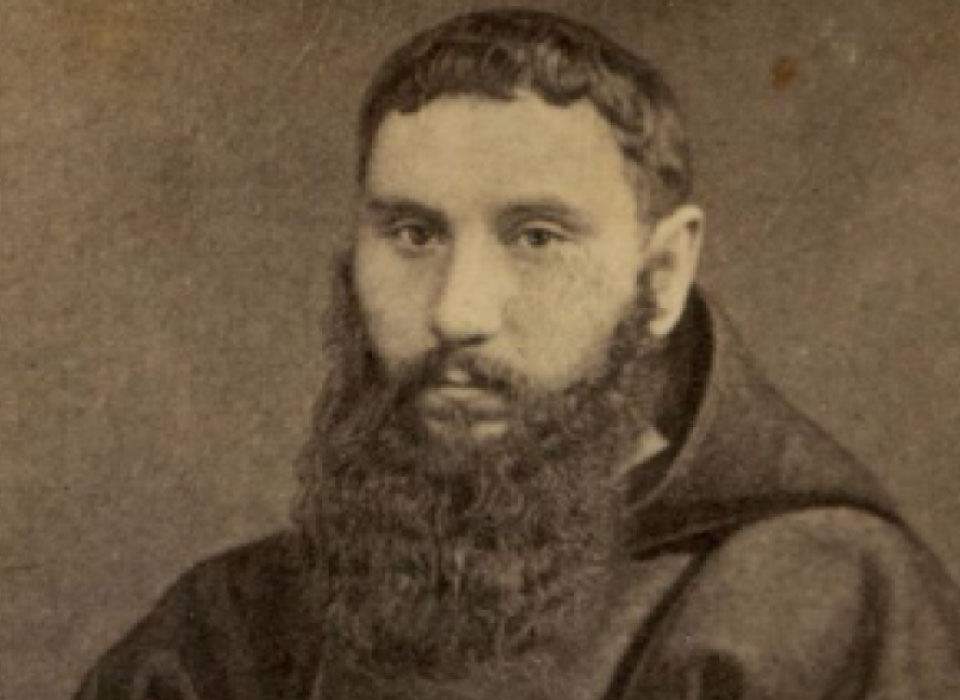
Bl. Honoratus Kozminski
Life (1829-1916)
Bd. Honoratus was born at Biala Podlaska, Poland, and baptized Florence Wenceslaus John Kozminski. His parents were in comfortable circumstances, and during his early years were a strong religious and cultural influence on him. Attracted to the career of an architect, which was his father’s calling, young Kozminski in 1844 entered the School of Fine Arts in Warsaw, his father’s Alma Mater. However, after the father’s death a year later, Wenceslaus fell victim to antireligious currents at the school, and not only ceased to practice Catholicism but became its declared enemy, trying to convert his Catholic companions to his altered religious views.
In 1846, he was accused of having taken part in a conspiracy against the Russians. The accusation was false, but the Russians, who then ruled Poland, clapped him into a frightful jail, and seemed ready to condemn him to death for treason. Prison became the battlefield of his soul. On the one hand, he caught a serious disease, probably typhus; on the other, he suffered a grievous spiritual temptation to abandon all religion. However, on the feast of the Assumption, 1846, Kozminski suddenly recovered his religious faith. When released from jail a year later, he made a public confession of his apostasy. His conversion he attributed to the grace obtained for him by Our Lady and to the faithful prayers of his mother.
Nor did his change of heart cease with recovery of faith. In December 1848 Wenceslaus joined the Capuchin Franciscans, taking the religious name Honoratus. Ordained a priest four years later, he began pastoral work in and around Warsaw as a confessor, preacher and prison chaplain. He also helped Maria Angela Truszkowska to found the Congregation of the Felician Sisters; and to increase the piety of the faithful he founded a number of “Circles of the Living Rosary”.
But the spies of imperial Russia were still on the alert. After Poland’s unsuccessful revolt for independence in 1863, Russia suppressed the Capuchin house in Warsaw. Honoratus and his fellow friars had to move to Zakroczym. There they lived under constant surveillance by the secret police, forbidden to leave the monastery or move elsewhere. Kozminski meanwhile kept busy at his religious duties. Each week he spent hours in the confessional and in spiritual direction. He focused particularly on young people who, like himself, had strayed from the church. In making these contacts with people who sought his advice, he found that many were considering emigrating to some place where they could enter the religious life, which the Russians were trying to discourage in Poland. Friar Honoratus thought that such aspirants might be satisfied if there were available some type of religious association that might satisfy them and at the same time permit them to stay at home. What he did was to set up a new type of congregation based on the Third Order of St. Francis. Like tertiaries, the members could take simple vows and live in community without being required to identify themselves outwardly as members of a religious order. The plan worked, and he set up, in all, 26 of these congregations. Members continued at their daily occupations while engaged in a secret apostolate to fellow workers. Certain of the centers had more specific apostolates. Some specialized in preaching, others in various social projects. In other words, the Congregations were an early form of our present-day secular religious institutes.
Eventually Honoratus wanted to put the organization under the control of the bishops. At first, the hierarchy feared what Russia would do if they became involved in this new form of religious life. However, when the Russian overlords became a bit more tolerant in 1905, the episcopate accepted jurisdiction over the Congregations, and with the approval of Rome, began to change their mode of operation. Father Honoratus, although deeply disappointed by the alterations, accepted the deal. Thenceforth he had no further connection with the novel type of religious institute that he had invented. Friar Honoratus continued his own work as a confessor and spiritual director to the end of his life; still working under oppressive political conditions. He also served as commissary general of the Capuchins in Poland and published a number of religious writings.
Stricken by a painful illness, Honoratus of Biala Podlaska died on December 16, 1916. Pope John Paul II beatified him in 1988 as a man who had fought his way back from infidelity to a triumphant faith. — Father Robert F. McNamara
Scripture: Colossians 3:1-4
(Year A) No saint ever went to heaven on a bed of roses, laughing and cheerful and crowned with earthly joy. All of them followed a “Via Crucis”, with a crown of thorns on their heads, working and toiling amid a thousand afflictions. Certainly they were happy, because they had been touched by divine grace and enjoyed moments of celestial joy, sensing the presence of Christ crucified at their side, feeling Him bearing the weight of the cross with them, warming them with the warmth of His heart and, through the mist, they caught a glimpse of the glory and the blessedness, the joy unconfined that lay ahead. Good fortune was not the lot that they enjoyed on earth, in fact they kept their distance from it, they scorned it, and fled from it when it pursued them. They trembled before it far more than before the cross, towards which they stretched out their hands as to a safe harbour.
Once they had chosen the way of the cross, they never wished to abandon it. And God was generous in assigning crosses for them to bear, since He knows full well the value of suffering. When our divine Saviour once spoke to the disciples about the shameful death awaiting Him, Saint Peter, in an outpouring of love and with sorrow in his heart, rejected the very thought that the Master should suffer and protested: “Lord, this must never happen to you”. But the Lord turned to Peter and said: “Get behind me, Satan! You are an obstacle in my path, because the way you think is not God’s way, but man’s” (Mt 16:22-23). A person who thinks in God’s way does not refuse the cross or complain about it, knowing that it is the only hope, the only way to reach heaven, the sole means to holiness, the source of every grace, the way to acquire the highest degree of heavenly glory. Satan deludes his victims with worldly happiness, offers them a poisoned chalice of fleeting pleasures. God on the other hand offers the cross, which is the storehouse of unnumbered treasures and joys of the spirit and everlasting bliss. This is why the saints were happy to embrace it and never wished to be separated from It. They lived with the cross, they died with the cross, indeed they lived and died on it.
Pains and battles, temptations and moments of spiritual dryness, persecutions, hunger, and want and every kind of adversity were their daily bread. Through desert sands, under the scorching sun, across rocks and crags, ambushed by the enemy, and braving a thousand other dangers they were ever intent upon God, ever persevering and faithful, never stopping, never falling back, without complaining to God when the abundance of temporal consolations was withdrawn; never regretting their chosen way, always serene, trusting, courageous and fearless.
The saints, who bore these afflictions before us, are now rejoicing. God has wiped away their tears and relieved their sufferings, He has invested them with the martyr’s palm and the crown of glory. He has now shown himself to them, face to face; all those tears are now so many jewels on their royal robes, on their crowns of beauty. And why? Because they persevered. The Lord Jesus said: “You are the ones who have stood by me faithfully in my trials, and now I confer a kingdom on you”.
Perseverance is the grace among graces, it is everything, it is the most important value. Without it, all those holy deeds would have led to nothing; without it, every effort is in vain. In order to persevere, two things are necessary above all else: a robust and lively faith, and the capacity to act as faith dictates. (Sermons)
Collect
O God,
you willed to give to your priest, Blessed Honoratus,
a spirit of tender love for souls
to reconcile them with you.
Through his intercession
may we taste the sweetness of your forgiveness
and be joined with you in perfect charity.
We ask this through our Lord Jesus Christ, your Son,
who lives and reigns with you and the Holy Spirit,
one God, for ever and ever. Amen.